Ștefan cel Mare Central Park: How a 7-Hectare Plot from 1818 Became the Living Room of Chișinău’s Walking Tours
The reason Ștefan cel Mare Central Park is not merely a stop on Chișinău’s walking tours but the stop around which entire itineraries are built is not its size, but its density of readable history per square meter. At roughly 7 hectares, the park is modest by European capital standards, yet it contains within its boundaries the oldest public green space in the city, the country’s most important sculptural ensemble, a literary pantheon, a Soviet-era fountain, and a daily social ritual that no guided tour can manufacture. Walking tours stop here because the park does not require a guide to perform—it performs itself. The guide’s task is simply to translate what is already happening: elderly couples dancing on a Sunday afternoon, students meeting “by Pushkin,” and busts of poets whose identities were once considered dangerous enough to require careful framing. The park is the city’s living room, and every Chisinau walking tour is, in essence, a guided tour of someone else’s home.

From Military Engineering to the City’s First Public Garden
The park’s origins are imperial and utilitarian. It was laid out in 1818 by Russian military engineers, making it the oldest surviving public park in Chișinău. The initial enclosure was made of wicker branches, a detail that underscores how modest the enterprise began—this was not a grand European promenade but a practical green space carved out of a provincial capital still finding its shape. By the late 1860s, the wicker had been replaced by a cast-iron fence designed by Alexander Bernardazzi, the Odessa architect whose fingerprints are on much of Chișinău’s central architecture, and the fence itself was manufactured in Odessa.
The park’s early nineteenth-century planting was ambitious: some four thousand forest saplings were installed, alongside renovated pavilions, benches, artificial fountains, and flower beds. By 1984, according to the Encyclopedia of Chișinău, the park hosted approximately fifty species of trees, shrubs, and vines, including rare varieties. Today, only a handful of the oldest trees survive, estimated at nearly two hundred years old—living fossils that have witnessed every subsequent transformation of the city around them. This botanical layering matters for the walking tour: guides can point to a specific cedar or mulberry and anchor a century of history in a single trunk.
Pushkin, the Park’s First Ghost
The park’s identity for much of the twentieth century was inseparable from Alexander Pushkin. The Russian poet spent three years in exile in Chișinău in the 1820s, and local lore holds that he enjoyed resting in this garden. His bronze bust, funded by public subscription and unveiled in 1885, stands on a granite column near the central fountain. It was the third monument to Pushkin anywhere in the Russian Empire, a fact that speaks to Chișinău’s self-image as a cultured outpost. In 1949, the Soviet authorities formally renamed the park after Pushkin, and for decades it was known simply as Pushkin Park.
This naming history is precisely the kind of layered identity that walking tours are built to unpack. Even today, a local saying “let’s meet by Pushkin” means the park, not the bust specifically—the poet’s name has become a geographic coordinate. The post-independence renaming to Ștefan cel Mare și Sfânt did not erase Pushkin but recontextualized him: he remains in the park, but now as one voice among many in a space dedicated to a different national narrative. Guides can use this single bust to discuss imperial cultural policy, Soviet internationalism, and post-Soviet memory politics in one stop.

The Alley of Classics: A Pantheon Built in Stages
The park’s most significant cultural intervention is the Aleea Clasicilor (Alley of Classics), a long straight walkway cutting through the park from south to north, lined with busts of writers and cultural figures. The idea originated with sculptor Alexandru Plămădeală, but it was realized only in 1957, during the Khrushchev Thaw, when the first twelve busts were installed. The timing was not accidental. As historian Ion Varta noted, the Thaw created an “opportunity” that Moldovan cultural figures exploited to assert national identity within the Soviet framework. The first busts included Dimitrie Cantemir, Ion Creangă, Vasile Alecsandri, and Mihai Eminescu—figures whose Romanian cultural affiliation was, in the Soviet context, a quiet act of defiance.
The ensemble expanded significantly after independence. In the late 1980s and early 1990s, during the national revival movement, thirteen additional busts were added beyond the central fountain toward the 31 August 1989 entrance, and the placement became looser, spilling into side alleys rather than maintaining the strict symmetry of the original row. Today the alley holds approximately 28 to 30 busts, including Romanian writers like Lucian Blaga, Tudor Arghezi, and Nichita Stănescu, alongside Moldovan figures like Grigore Vieru. The result is a sculptural timeline of changing political permissible identities: what could be commemorated in 1957, what was added in 1990, and what continues to be added today.
For walking tours in Chisinau, the Alley of Classics is the park’s narrative spine. Guides stop at Eminescu’s bust to tell the urban legend that sculptor Lazăr Dubinovschi smuggled his own facial features into the poet’s hair—a story that humanizes the monumental and invites visitors to look closely rather than merely photograph. They stop at Grigore Vieru, near the northern entrance, to discuss the poet’s role in the late 1980s national movement. Each bust is a doorway into a different decade.

Book a city tour in Chisinau today
The Fountain, the Lions, and the Soviet Layer
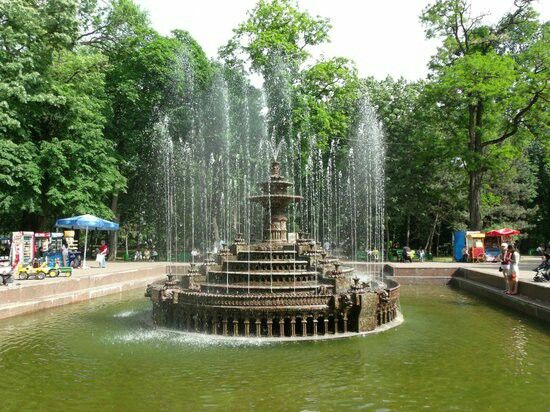
At the park’s geometric center sits a large circular fountain, reconstructed during the Soviet period with a stepped, five-level composition crowned by an elegant vase, its first tier adorned with metal fish sculptures in the style of socialist realism. Two marble lions flank the walkway near the fountain, symmetrically placed relative to the axis leading toward Ștefan cel Mare Boulevard. These lions were brought from the estate of Vasile Calmuțchi in Sângerei and are said to embody two virtues: guard and vigilance. Local tradition offers a more uncertain origin, suggesting they may have come from a manor destroyed in World War II.
The fountain and lions represent the Soviet layer of the park’s palimpsest—not the original 1818 garden, not the post-independence national revival, but the mid-century reconstruction that gave the space its current physical form. Guides who stop here are performing an act of archaeological reading: beneath the socialist-realist fish and the transplanted lions lies the earlier garden, and beneath that, the military engineers’ grid. The park is not one place but at least three, stacked vertically in stone, water, and bronze.
Why Tours Stop Here: The Park as Self-Guiding Experience
The practical reason walking tours pause in the park is that the park does not need the tour to be interesting. It is already full of people doing things. The “Dialog între Generații” (Dialogue Between Generations) project, initiated in June 2022, brings seniors to the park on weekend afternoons for music and dancing. Komoot’s route descriptions note that “the Dancing of the Generations always takes place on Sunday afternoons” and describe it as “a very popular event”. A recent visitor review describes encountering elderly people dancing on Europe Day, May 9, “enjoying beautiful moments together”. This is not staged heritage; it is the park’s actual social life, and it happens to be exactly what tourists hope to see when they book a “local experience” tour.
The park’s nickname, the “lovers’ park,” adds another layer of local meaning that guides can invoke. It is where Chișinău residents come to read, meet friends, sit in the shade, or spend time with someone special—ordinary uses that make the park legible to visitors as a real place rather than a monument. The park has seven entrances, a detail that matters for tour logistics: groups can enter from the Ștefan cel Mare Boulevard side, pass the Stephen the Great monument at the park’s edge, walk the Alley of Classics, pause at the fountain, and exit toward the Triumphal Arch and Cathedral without ever retracing a step. The park is a thoroughfare as much as a destination.
The Smallest Monument and the Largest Lesson
Among the park’s curiosities is a statue of the Little Prince, reportedly only 11 centimeters tall, the smallest monument in Chișinău. It is easy to miss, and that is precisely its function on a walking tour: it rewards attention. A guide who knows where it is demonstrates local knowledge; a visitor who finds it independently feels initiated. The Little Prince sits alongside the marble lions, the Pushkin bust, the Eminescu legend, and the dancing seniors as part of the park’s pedagogy of small things. The park teaches that history in Chișinău is not always monumental—sometimes it is a wicker fence replaced by iron, a poet’s chin hidden in another poet’s hair, or an 11-centimeter figure waiting to be noticed.
The Park as the City’s Autobiography
Ștefan cel Mare Central Park is the stop on Chișinău’s walking tours where the city stops performing its history and simply lives it. The 1818 military grid, the 1885 Pushkin bust, the 1957 Alley of Classics, the Soviet fountain, the post-independence busts, the weekend dances—these are not separate attractions but layers of a single continuous habitation. Guides bring tours here because the park compresses two centuries of imperial, Soviet, and national transformation into a walkable seven hectares, and because the park’s own residents are already doing the work of interpretation: meeting by Pushkin, dancing on Sunday, sitting under trees that predate every political regime currently competing for their allegiance. The park is not a monument to Chișinău. It is Chișinău, in the habitual tense.
Book your Chisinau walking tours here