How to Get to Comrat in Gagauzia: Every Travel Option, and Why a Guided Tour Is Worth It
Comrat is the kind of destination that rewards a little planning but punishes overcomplication. As the capital of Gagauzia—Moldova’s autonomous, Turkic-speaking, Orthodox Christian region—it sits roughly ninety minutes south of Chișinău, far enough to feel distinctly different but close enough for an easy day excursion from Chisinau . The road signs change language, the churches follow a different rhythm, and the whole place quietly dismantles whatever assumptions you arrived with. Getting there is straightforward, but the way you get there shapes what you actually experience. Below is a full breakdown of your options, followed by a candid argument for why handing the logistics to a guide often makes the difference between seeing Comrat and understanding it.
The Independent Options: Buses, Marshrutkas, Taxis, and Trains
The Marshrutka: The Backbone of Local Travel
The most common and economical way to reach Comrat is the marshrutka—a minibus that runs from Chișinău’s Southern Bus Station, known locally as Gara de Sud. These leave roughly every hour, though the schedule is more of a suggestion than a contract . You buy your ticket at a booth near the departure stand (Stand 16 is the usual spot), and the fare runs around 67 Moldovan lei, or roughly $3.80 USD . Payment by card is sometimes accepted at the booth, but cash is the safer bet.
The journey itself takes between one and a half and two and a half hours, depending on traffic, road conditions, and the driver’s personal relationship with the speed limit . The ride is not luxurious—carpeted ceilings, minimal legroom, and a driver who may be managing two phones—but it is direct and deeply local. You arrive at Comrat’s bus station on Strada Victoriei 2, right in the heart of town, a short walk from the central park and the Cathedral of St John the Baptist .
For return trips, marshrutkas leave Comrat for Chișinău’s Southern Bus Station starting as early as 6:00 AM, with departures continuing through the day until around 7:00 PM . Buying a return ticket in Comrat can be a minor linguistic adventure; the ticket seller may not speak English or Romanian, and patience (or a helpful driver) goes a long way.

The Standard Bus: Slightly More Structure
If you prefer a vehicle with a fixed schedule and a slightly more formal ticketing system, companies like SVS.MD operate buses on the Chișinău–Comrat route. These depart from Gara Sud, take about one hour and twenty-five minutes, and cost roughly the same as a marshrutka—around 47 Chinese yuan or its equivalent, which lands in the same few-dollar range . There are typically only a few departures per day (the earliest around 1:50 PM and the latest around 4:45 PM according to one aggregator), so this option requires more rigid planning than the marshrutka’s hourly rhythm .
One practical warning: online schedules for this route are not always reliable, and the distinction between a “bus” and a “marshrutka” in Moldova is fluid. Treat any booking platform’s timetable as a starting point, not gospel.
Taxi or Rideshare: Convenience at a Cost
A taxi from Chișinău to Comrat takes about an hour and twenty minutes to an hour and a half and costs somewhere between $26 and $31 USD if arranged through a rideshare app like YandexGo, or more if you hail a traditional taxi . The advantage is door-to-door service and the ability to leave on your own schedule. The disadvantage is that you miss the communal texture of the marshrutka and arrive without the gentle decompression that a shared ride provides. For solo travelers on a budget, the taxi is hard to justify; for small groups or travelers with heavy luggage, it can make sense.
The Train: Technically Possible, Practically Irrelevant
Comrat does have a railway station, but it is located in the village of Bugeac, about seven kilometers north of the city . Passenger service to this station is not a realistic option for most visitors, and no reliable scheduled trains connect Chișinău to Comrat for tourist purposes. Treat the train as a historical curiosity rather than a travel plan.
Border and Entry Considerations
Gagauzia is an autonomous region within Moldova, not a separate country. Traveling to Comrat from Chișinău involves no border control, no passport checks, and no special permits . This is worth emphasizing because Gagauzia’s political distinctiveness—its own assembly, its own governor, its three official languages—can create a vague impression that it is somehow separate. It is not. You simply drive south, and the signs change. This is the opposite of Transnistria, where entry involves checkpoints and migration cards .

Book a Gagauzia day trip today
Why a Guided Tour Changes the Equation
The Logistics Cease to Be Your Problem
A guided tour from Chișinău eliminates every friction point described above. Reputable operators offer hotel pickup, private or small-group transport, and a fixed itinerary that includes Comrat and often surrounding villages like Beșalma, Congaz, or Ceadîr-Lunga . You do not need to find Gara de Sud, decipher the marshrutka stand, or negotiate a return ticket in a language you do not speak. For travelers with limited time—say, a single free day in Moldova—this efficiency is not a luxury; it is the difference between visiting Gagauzia and not seeing it at all.
The Cultural Context You Cannot Get from a Guidebook
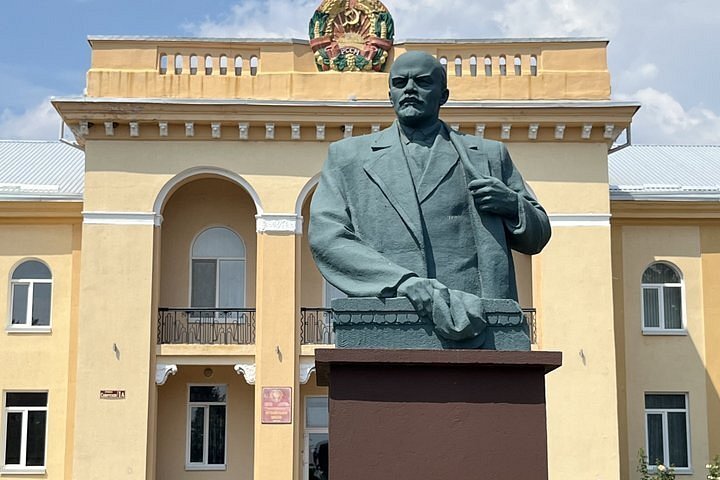
Comrat’s surface is modest: a yellow-and-gold cathedral built in 1820, a regional history museum, a Walk of Glory with Soviet-era monuments, an “I heart Comrat” sign . Without context, these are pleasant but opaque. The Gagauz are a Turkic people who practice Orthodox Christianity, a combination that confounds most visitors’ mental categories . Their language is closer to Turkish than to Romanian, but their religious and political orientation has historically leaned toward the Russian world. They declared independence in 1991, then negotiated a peaceful autonomy settlement in 1994—one of the rare post-Soviet disputes resolved without war .
A good guide connects these dots. They explain why the museum’s exhibits on wedding ceremonies and traditional crafts matter, why the Lenin monument in front of the City Hall coexists with a Gagauz national university, and why Gagauzia holds disproportionate influence over Moldova’s future direction . This is not trivia. It is the difference between taking photographs of monuments and understanding what those monuments are arguing about.

Access to Experiences Independent Travelers Miss
Guided tours to Gagauzia frequently include elements that would be difficult, time-consuming, or simply unknown to an independent visitor. One popular itinerary includes a cooking masterclass with a local family, where you learn to prepare gözleme (stuffed flatbread) and kiirma (a hearty meat and vegetable dish), followed by a traditional feast at the Gagauz Sofrası complex in Congaz, complete with folklore performances . Another includes a visit to a horse farm in Ceadîr-Lunga and a stop at a “secret spot” with panoramic views . A private cultural tour might take you to the Dmitriy Kara Çöbän Ethnographic Museum in Beșalma, where traditional clothing, household artifacts, and historical photographs illustrate how Gagauz families preserved their identity through generations . Some tours venture further off the standard path, visiting an abandoned Soviet airport with a preserved Antonov An-2 aircraft or a House of Culture left in decay after a fire—places that reward curiosity but require local knowledge to find .
These are not gimmicks. They are the texture of the region, and they are considerably harder to arrange on a marshrutka schedule.
The Language and Navigation Buffer
Moldova’s linguistic landscape is layered: Romanian is the state language, Russian is widely spoken, Gagauz and Turkish circulate in the south, and English is present but uneven. In Comrat, you may encounter signs in Gagauz, Russian, and Romanian within the same block . A guide fluent in the relevant languages smooths every transaction, from ordering lunch to asking directions to understanding why the museum curator is explaining something with particular urgency. This is not about helplessness; it is about allocating your mental energy to observation rather than administration.
The Ethical Dimension: Supporting Local Guides and Families
Guided tourism in a region like Gagauzia has a quiet economic logic. When you book a tour that includes a family cooking class, a local lunch, or a visit to a community museum, your money circulates through households and small institutions that may not see much international traffic . The Gagauz Sofrası complex in Congaz, the ethnographic museum in Beșalma, the horse farm in Ceadîr-Lunga—these are not corporate attractions. They are local enterprises and cultural institutions. A guide who maintains relationships with them is also a guide who can advocate for them. Independent travel has its virtues, but it does not automatically distribute benefit as widely.
A Practical Recommendation
If you have the time and the temperament for slow travel, the marshrutka from Gara de Sud is a perfectly good way to reach Comrat. It is cheap, frequent enough, and puts you in direct contact with the region’s everyday rhythm. Spend a night, walk the city center, visit the cathedral and the museum, and let the place settle.
But if your time in Moldova is limited—most visitors give the country only a few days—or if you want to understand Gagauzia rather than simply photograph it, a guided tour is the more intelligent choice. The best tours are small-group or private, include pickup from your accommodation in Chișinău, and combine Comrat with at least one surrounding village and a meal prepared by local hands . They cost more than a marshrutka ticket, but they buy you context, access, and the absence of logistical friction. In a region whose entire identity is about navigating between categories—Turkic and Orthodox, Moldovan and autonomous, Soviet and European—that context is not a bonus. It is the point.
Book a private guided tour to Comrat today