The Triumphal Arch of Chișinău: A 13-Meter White Stone Arch That Became the Default Coordinate of Every Walking Tour
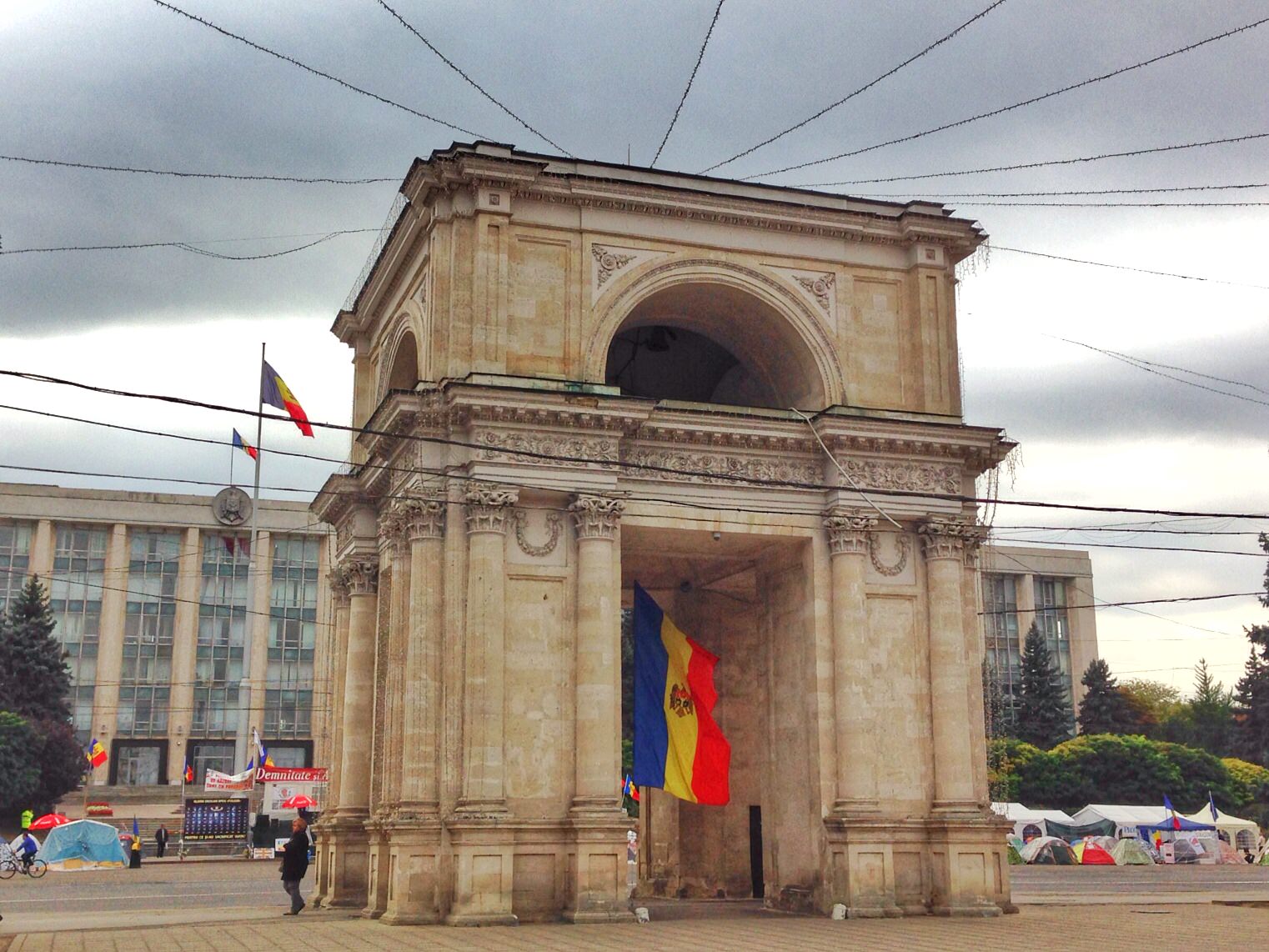
The reason Chișinău’s Triumphal Arch appears on virtually every guided walking tour is not that it is large, but that it is precise. This white stone arch, standing only 13 meters tall and built in the 1840s, sits exactly at the geometric center where the Cathedral Park meets the capital’s main axis. For guides, it is a natural narrative hinge: facing north, one can discuss the war and the bell cast from captured cannons; facing east, the Soviet-era renaming and destruction; facing south, the post-independence reconstruction of national symbols. For visitors, it is an effortless meeting point and a “compressed file” that can be read in a single glance—a layered history of the city of Chisinau in one view. The structural restoration launched in early 2026 makes it, by 2027, a live case study of how Moldova treats its own heritage.
An Arch Born Because a Bell Was Too Big
The motivation behind the construction of the Triumphal Arch differs from most of its European counterparts. It was not planned independently as a pure military monument, but was “forced” into existence by a specific engineering problem. After the Russo-Turkish War of 1828–1829, Tsar Nicholas I ordered captured Turkish cannons to be melted down and cast into church bells. The Kyiv craftsman Vasily Losenko cast three bells, the largest weighing 6.4 tons—the heaviest in Chișinău at the time. This giant bell was intended for the main cathedral bell tower, but upon completion, it was discovered that its dimensions far exceeded expectations, and the bell tower could not support it. Consequently, the authorities decided to build a structure adjacent to the cathedral that would serve both as a triumphal arch and a bell tower. The giant bell was finally hoisted to the arch’s second level in August 1839 .

This detail explains a frequently overlooked feature of the Triumphal Arch: inside one of its pillars is a metal ladder leading to the second level where the bell and clock were housed . The building was designed by Odessa architect Luca Zaușkevici, inspired by its Roman namesake, with a square plan of four pillars and four arches, Corinthian-style capitals, and polished white stone throughout . Its siting was aligned on a strict axis with the Nativity Cathedral (begun 1830) and the bell tower (1835), embedding it from the outset into the city’s core spatial order rather than existing as an isolated monument.
Names and Identities in Repeated Flux
The Triumphal Arch has undergone at least three name changes over nearly two centuries, each corresponding to a shift in political power and ideology. During the Imperial Russian period, it was called the “Holy Gates,” serving both triumphal commemoration and bell tower functions. During the Soviet era, it was renamed the “Arch of Victory,” and in 1945, marble memorial plaques were affixed to the arch inscribed with the names of Soviet heroes who fought on Moldovan territory during World War II. These inscriptions were removed after Moldova’s independence in 1991 . Today, the official and tourism materials use the name “Triumphal Arch,” while locals occasionally still use the old name “Holy Gates.”
More destructive than the renaming was the fate of the surrounding architectural ensemble. In 1962, Soviet authorities demolished the cathedral bell tower on the grounds of “preventing its use as a sniper position,” and a fountain and amusement facilities were successively built on the site . The arch itself was not demolished, but the fate of its iconic 6.4-ton bell was equally circuitous: according to tourism sources, the bell remained inside the arch until 2011, when it was removed . In 1998, the bell tower was reconstructed based on historical photographs, and the architectural ensemble of Cathedral Park recovered the trinity visitors see today: cathedral, bell tower, and Triumphal Arch. The arch thus became a rare “specimen of continuity”—it was never torn down itself, yet it witnessed the demolition and reconstruction of the buildings beside it.

Book a Chisinau walking tour today
Clocks, Restoration, and the Material Life of an Arch
The mechanical clock still mounted on the arch’s facade strikes every fifteen minutes and is illuminated at night . The history of this clock alone could fill a micro-history of Chișinău’s technology. The first clock was purchased with donations from the Bessarabian governor from the Odessa craftsman Helzel and installed on August 3, 1839. In 1880, it was replaced by a product from the Hertz factory in Ulm, Germany. During the early years of World War II, the clock was destroyed in an explosion and repaired in 1942 at a cost of 18,000 lei . The clock face visitors see today is already the latest in a lineage of timekeeping successors.
More significant in contemporary terms is the restoration project announced in 2026. The Moldovan Government approved a decision in September 2026 establishing the legal conditions for restoration, with the Ministry of Culture’s budget including 5 million lei for technical documentation and a feasibility study . Culture Minister Dan Suruceanu stated that administrative and technical processes were to be completed by the end of 2026, with procurement and contractor selection in 2027, and construction work beginning in March or April . Prime Minister Vasile Tofan also indicated that the authorities were seeking sponsors from the business community to finance the restoration, so that the funds would not come entirely from the state budget . The arch covers an area of 131.2 square meters and is part of the “Holy Gates and Square” ensemble listed in the Register of State-Protected Monuments .
Why Walking Tours Stop Here
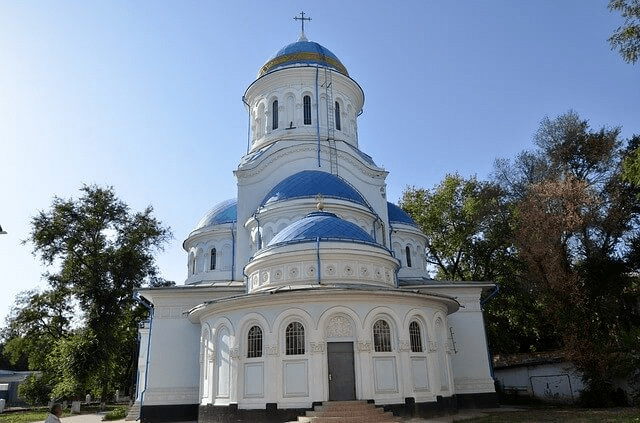
To understand the irreplaceability of the arch as a tour stop, one needs to look at its position in actual tourism products. Walking tour listings across multiple platforms show that the Triumphal Arch is almost never listed alone, but always bundled with the “Cathedral,” “Cathedral Park,” and “Stephen the Great Monument” on the same route. A typical 2–3 hour evening walking tour in Chisinau starts at the Stephen the Great Monument, then passes the Triumphal Arch and Cathedral, before turning onto Eugen Doga pedestrian street . Another immersive tour begins directly at Cathedral Park, with the arch and the Nativity Cathedral listed together as “symbols of the city’s identity and history” .
The logic of this route design is spatial rather than purely a ranking of historical importance. The arch stands at the edge of Cathedral Park, at the node of the capital’s main axis; entering the city center from any direction requires passing it. Guides stop here not because they need to explain an isolated arch, but because standing at this point allows them to point in three directions simultaneously: pointing at the cathedral, to discuss its closure during the Soviet period and reopening in the 1990s; pointing at the arch’s second level, to discuss the giant bell cast from enemy cannons; pointing at the park clearing, to discuss the bell tower rebuilt in 1998. One stop, three narrative threads—this is the most economical spatial strategy for a walking tour.
For visitors, another layer of the arch’s appeal lies in its “legibility.” It is not tall, has no fences, sells no tickets; visitors can walk beneath the arch and touch the stone pillars, can read the clock’s hands, and can frame the cathedral’s golden dome, the white stone arch, and the park’s canopy in a single shot. This zero-barrier intimacy contrasts with many fenced-off triumphal arches in Europe. The government tourism website describes it as “a popular meeting point for locals and a must-see for visitors,” a positioning that precisely captures its dual identity: a geographic reference in daily life and a symbolic gateway to the tourism experience .
The Large Lesson of a Small Arch
The value of Chișinău’s Triumphal Arch lies precisely in its lack of “grandeur.” At 13 meters, it is not prominent among triumphal arches; it lacks the sculptural groups of Paris and the scale of Rome’s Arch of Constantine. But it possesses two things most of its counterparts do not: a bell cast from enemy weapons, and a bell tower demolished and rebuilt beside it. The former transformed the commemoration of military victory into an instrument of religious and community life; the latter made the arch a silent witness to the vicissitudes of the city’s fate. When walking tour guides pause visitors beneath the arch, what they truly point to is not a white stone building from the 1840s, but a restoration site still in progress, a material life sealed by cement and reopened, and the way a city has repeatedly defined itself across Imperial Russian, Soviet, and independent Moldovan eras. The arch is the default coordinate of the tours because it is itself a coordinate—marking not only the location of the city center, but the precise scale of a nation searching for its own outline among multiple imperial legacies.
Book a sightseeing tour in Chisinau