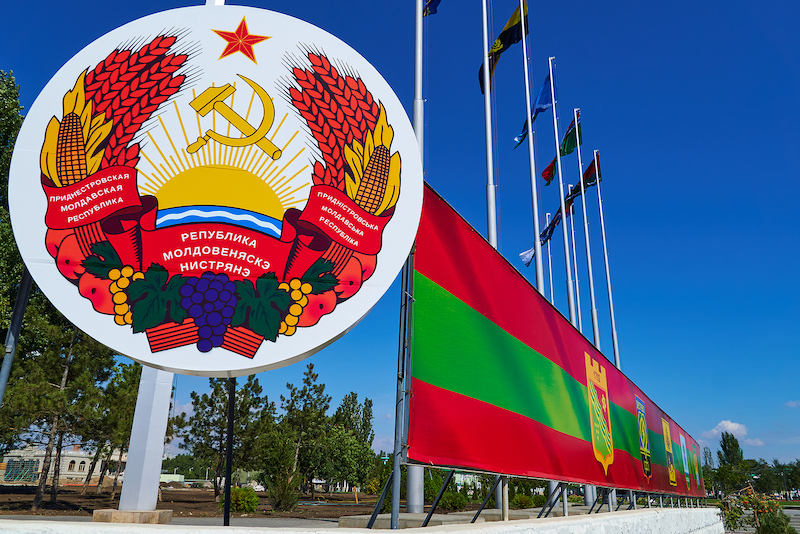
In the heart of Tiraspol, the capital of the unrecognized Pridnestrovian Moldavian Republic (Transnistria), stands a building that refuses to be ignored. Its white colonnade casts precise shadows across the city’s central axis. A silver spire pierces the sky, crowned by a red star that has watched over this land for nearly seventy years. This is the House of Soviets — Tiraspol’s city hall, and the most iconic architectural landmark in a city that often feels like a living museum of the Soviet past.
For any visitor wandering the streets of Tiraspol, the House of Soviets is more than an administrative building. It is a time capsule, a political statement, and a testament to the dramatic geopolitical shifts that have shaped this narrow strip of land between the Dniester River and the Ukrainian border.
Architectural Origins: The Last Breath of Stalinist Empire
The House of Soviets was built between 1953 and 1956, designed by architect S.V. Vasilyev. Its construction began in the year of Stalin’s death, yet its aesthetic soul was entirely rooted in the architectural language of his era.
The building is a textbook example of Stalinist Empire style (Stalinsky Ampir), a post-war architectural movement that fused classical grandeur with Soviet monumental symbolism. This style aimed to project the invincibility and eternal triumph of the Soviet state through grand scales, classical columns, and ornate decorations.
What makes the Tiraspol House of Soviets remarkable is its near-perfect preservation. Unlike many similar buildings across the former Soviet Union that were stripped of their decorative elements during Khrushchev’s “de-Stalinization” campaigns, this building retains almost all of its original ornamentation — from the laurel wreaths to the intricate cornices. It stands as one of the best-preserved Stalinist administrative buildings in the region. Learn more about Tiraspol on a private tour to Transnistria.
Architectural Features: The Ten-Column Portico and Spire
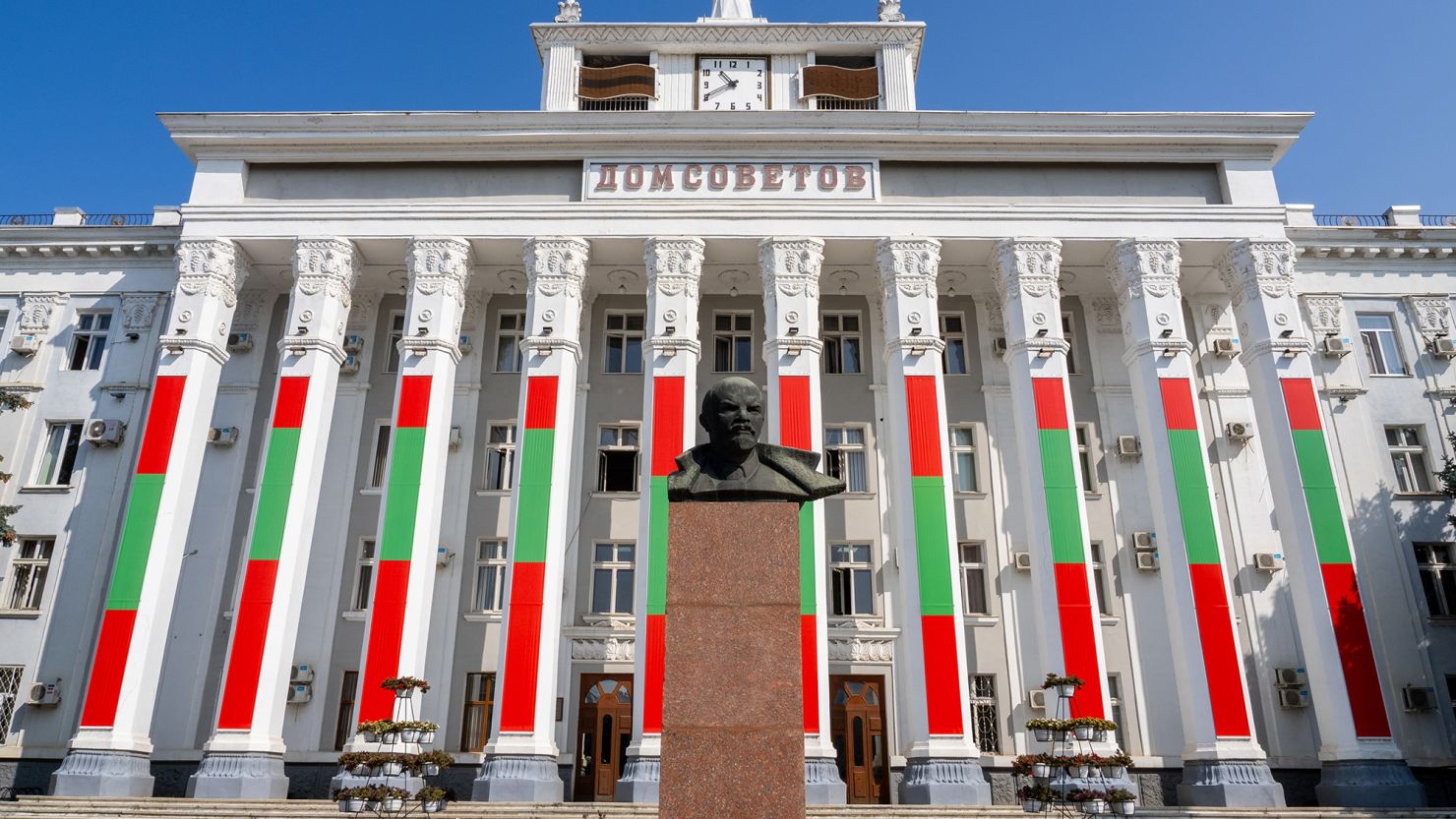
The House of Soviets is a four-story rectangular building, but its visual impact far exceeds its physical height. The most striking feature of its main façade is the monumental ten-column portico. This is extraordinarily rare for a provincial administrative building — most such structures featured six or at most eight columns. The choice of ten columns was a deliberate statement of ambition, signaling Tiraspol’s importance as a regional center within the Moldavian Soviet Socialist Republic.
Above the colonnade, the building rises into a tower-like structure, culminating in a spire topped with a red star. Interestingly, this spire was originally designed to be taller. When construction neared completion in 1955, Khrushchev’s campaign against “architectural excesses” was in full swing. The spire’s height was reduced, but the essential Stalinist silhouette survived.
The façade is painted a stark white, with the Russian inscription “Dom sovetov” (House of Soviets) above the entrance. A row of fir trees lines the exterior walls, adding a touch of solemn greenery to the austere architecture. The building is a frozen symphony of power aesthetics — a visual manifesto of an era that has passed but refuses to fade.
The Gaze of Lenin: The Statue at the Entrance
Directly in front of the House of Soviets stands a bust of Lenin, his eyes fixed on a horizon only he could see. For visitors to Tiraspol, this statue carries special symbolic weight. One traveler on Tripadvisor remarked that arriving here feels “like being in Russia, because many cities there still have Houses of Soviets and Lenin statues.” Another described it as the starting point for “experiencing the old Soviet atmosphere.”
This bust is smaller than the full-figure Lenin statue elsewhere in Tiraspol (opposite the Supreme Soviet building), but its placement before the House of Soviets makes it more intimately connected to the daily life of the city. Under his watchful gaze, Tiraspol residents still stroll down October 25 Street toward the river, maintaining a rhythm of life that has remained unchanged for decades.
The Clock and Its Bells: A Story of Return
The clock on the House of Soviets tower is not original to the building. Its story reflects the city’s later Soviet-era transformations.
The clock was installed in October 1974, commemorating the 70th anniversary of the Moldavian Soviet Socialist Republic. It was crafted by two watchmakers — Vladimir Fyodorovich Tsibarov and Valentin Akimovich Potapov. Initially, the chimes came from a mechanism using a bell from the Kitskani Monastery.
In 1989, that monastery bell was returned to the church. As a replacement, the Kirov Factory manufactured a new bell weighing 120 kilograms, with a brighter, clearer sound. The electric motor was produced by the “Elektromash” factory.
On April 12, 1999 — the anniversary of Tiraspol’s liberation — at noon, after a decade of silence, the city’s chimes rang out once more. This moment reconnected the past with the present, making the House of Soviets clock the city’s temporal heart once again.
Political Theater: From Soviet Power to Transnistrian Statehood
The House of Soviets is more than architecture. It has witnessed the most turbulent political moments in Transnistrian history.
From 1990 onward, the building became the seat of power for the newly proclaimed Pridnestrovian Moldavian Republic (PMR). It transformed from a municipal building into the political heart of an unrecognized state.
The most dramatic episode occurred in autumn 1990. Members of the so-called “Ilashku Group” attempted to raise the Romanian tricolor flag atop the House of Soviets — a gesture of support for the Moldovan nationalist movement. They were stopped. Six workers from the Kirov Factoryblocked them at the threshold of the building.
This event has been canonized in Transnistrian historical narrative as a symbol of the struggle for independence. The House of Soviets thus became “one of the symbols of the struggle for the establishment of the Pridnestrovian Moldavian Republic.”
Inside and Around: Memorials and Honored Citizens
Today, the House of Soviets remains the seat of the Tiraspol City Council and Municipal Committee. Inside, there is a memorial to those who died in the 1992 conflict.
Near the building, a long wall displays photographs of the city’s honorary citizens. The list itself is a miniature history of the Soviet and post-Soviet eras: labor heroes, World War II veterans, cosmonauts, former Moscow mayor Yuri Luzhkov (1992–2010), and Igor Smirnov, who led Transnistria from 1991 to 2011.
A memorial plaque also commemorates V.G. Sinev — an honorary citizen of Tiraspol, chairman of the city executive committee from 1971 to 1986, and a member of the PMR government.
National Symbol and Cultural Footprint
The House of Soviets has transcended its role as a municipal building. It has been featured on multiple commemorative coins issued by the Pridnestrovian Republican Bank:
-
A 2002 silver coin (100 rubles) for the 210th anniversary of Tiraspol
-
A 2005 silver coin (100 rubles) for the 15th anniversary of the PMR
-
A 2006 gold coin (15 rubles) on the same theme
The building also appeared on screen. In the 1959 Soviet film “Don’t Have 100 Rubles…”, the House of Soviets was used as the Ministry of Finance building.
For contemporary travelers, the House of Soviets is the centerpiece of Tiraspol’s “open-air Soviet museum” experience. Together with other Soviet-era remnants, it creates a unique time-travel experience. As one reviewer put it, it is “the most beautiful building in Tiraspol,” photogenic in sunshine and under clouds alike, and especially beautiful when illuminated at night.
The Weight of Time in a Single Building
The House of Soviets stands on October 25 Street, its white façade reflecting the sunlight off the Dniester River. It is a monument to architecture and a testament to an era.
Its ten columns still stand tall. Its red star still shines. Its Lenin still gazes forward. The building has not been renovated, demolished, or forgotten. It simply continues to exist — a time capsule preserving the architectural ambitions of the 1950s, the political passions of the 1990s, and the daily breath of a city that still calls itself “Soviet.”
For Tiraspol, the House of Soviets is not merely a city hall. It is a calling card handed to the world, inscribed with a simple message: This was once the Soviet Union. In many ways, it still is. One of the best ways to discover Transnistria is a private organised tour in Moldova.

Book a Tiraspol private tour with Moldova tours.