The Romanita Tower: Chișinău’s Concrete Flower and the Compulsion of Soviet Nostalgia
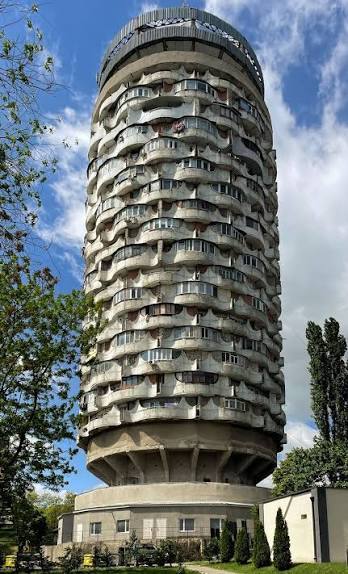
The Romanita Collective Housing Tower is the single most photographed, most debated, and most urgently visited Soviet-era building in Chișinău—not because it is beautiful, but because it is disappearing. A 73-meter concrete cylinder with 22 floors and 165 apartments, Romanita was once the tallest residential building in the Moldovan capital . Today, it stands as a gray, deteriorating monument to late-Soviet ambition, its facade disfigured by decades of unregulated balcony enclosures, its future uncertain . For tourists drawn to the aesthetics and contradictions of the Soviet past, Romanita is not merely a stop on a tour—it is a pilgrimage site. Every Soviet-themed city tour in Chișinău, from Chisinau vintage Lada drives to walking excursions, includes it as a mandatory waypoint . The building’s appeal lies precisely in its paradox: a structure designed as a showcase of socialist housing now serves as a case study in post-Soviet decay, and the knowledge that it may not survive makes seeing it feel urgent.
A Flower of Concrete and Steel
Romanita was built between 1978 and 1986, designed by architect Oleg Vronsky and engineer A. Marian . Its popular name derives from the Romanian word for “chamomile,” a reference to its circular plan and the way its residential floors radiate outward from a central reinforced-concrete core . The engineering was genuinely innovative for its time: sixteen of the twenty-two floors cantilever outward without supporting columns beneath them, held aloft solely by the central core . This structural audacity gave the tower its distinctive slender silhouette when viewed from a distance, and its dizzying, top-heavy presence when approached from below.
The building’s original purpose was housing, conceived during a period of acute shortage in Chișinău. Soviet norms at the time allotted approximately six square meters per person . Each residential floor contained eight apartments arranged around a circular corridor with natural lighting; the apartments themselves were small two-room units with a hallway and bathroom, while kitchens and communal areas were shared . The design reflected the collectivist logic of late-Soviet housing policy: private space was minimal, and communal infrastructure was meant to compensate.
Myths accumulated around the project almost immediately. One persistent story held that the building was originally commissioned as a sanatorium for employees of the USSR Ministry of Construction, with plans for a rotating restaurant, cinema, gymnasium, library, and banquet hall at the top . Vronsky himself dismissed the rotating restaurant claim, noting that there was neither sufficient space nor, at the time, the technology in Chișinău to build such a mechanism . Another version insisted the tower was conceived as a hotel intended to generate revenue for the treasury . What is certain is that Romanita was completed and commissioned as housing, and by 1997 its legal status shifted from dormitory to residential building .

The Slow Unraveling
The building’s post-Soviet history is a case study in the unintended consequences of privatization and neglect. After apartments were privatized in the 1990s, residents began expanding their cramped living spaces by enclosing balconies—first with glass, then with brick, wood, and concrete . These ad hoc additions, undertaken without coordinated oversight, gradually transformed the tower’s clean cylindrical facade into a patchwork of protruding volumes. More troublingly, the added weight placed additional stress on the cantilevered structures that had been engineered for a precise load . The frame itself remains stable, but the building is widely recognized as being in need of major repair .
The condition of Romanita has attracted international attention of a kind no architect would wish for. In 2019, the Franco-German channel ARTE produced a documentary segment initially titled “The Ugliest Building in the World,” a label that stuck in popular discourse even after the title was criticized and changed . The building has been marked for demolition twice, according to local guides, though the municipality has repeatedly postponed action due to lack of funds . In 2025, two people were found dead in the building’s abandoned technical spaces, and residents were evacuated, drawing renewed attention to the tower’s deteriorating conditions . A local guide who regularly brings tourists to Romanita describes the experience with a mixture of admiration and resignation: “As a tour guide, I always take my tourists there to admire its monumentality. Its top floor opens to a spectacular view over Chisinau and I try to keep that in my memory, because one day, most certainly, Romanita will be demolished”

Soviet era brutalist tour Moldova
Why Soviet Nostalgia Tours Stop Here
The commercial Soviet tour circuit in Chișinău has made Romanita a fixture for reasons that are both practical and symbolic. A private Soviet city tour conducted in a vintage Lada, one of the most popular offerings on GetYourGuide, explicitly lists “the Romanița tower, a local landmark nicknamed the ‘chamomile'” as a scheduled stop between the city center and the Central Market . The building’s location on the route from Chișinău Airport toward the historical center means it is often the first Soviet-era structure visitors see, a massive gray cylinder rising above the surrounding low-rise Malina Mică district . For tour operators, it is a free, accessible, and visually striking waypoint that requires no tickets and no scheduled hours.
But the deeper appeal is thematic. Tourists interested in Soviet nostalgia are not seeking pristine monuments; they are seeking authenticity, and authenticity in post-Soviet space is often measured in decay. Romanita offers something that restored buildings cannot: evidence of time, use, and abandonment. The misnumbered elevator buttons that visitors describe with amusement—”a fun game of figuring out which wrongly numbered button brings you to which floor”—are not a designed feature but a symptom of decades of ad hoc maintenance . The “flying saucer” structure on the roof, which once suggested a futuristic vision, now reads as a relic of a future that never arrived . Travel platforms categorize the building under “brutalist architecture” and “Soviet social housing,” and user reviews emphasize exactly these qualities: “one of the most interesting and complex communist buildings in Chisinau,” “an impressive example of soviet social housing” .
The Scholarly Case for Preservation
Romanita’s value is not only touristic. A scholarly article published through Heidelberg University’s journals argues for the building’s urgent inclusion in Moldova’s Register of Historical Monuments, alongside the National Hotel, Cosmos Hotel, and State Circus . The authors acknowledge that Romanita’s chronological age is low, but argue that its “planimetric and structural coherence” and its representation of socialist-period ideology give it high value. The building “highlights the ideology of the socialist period, being representative of the way collective housing… were built and of the compliance of buildings with collective housing programmes” . The article proposes that restoration could contribute to “tourist and socio-economic development,” potentially converting the tower for small family units or other uses that would preserve its architectural identity while adapting it to contemporary needs . Whether such a vision will be realized remains uncertain, but the scholarly attention confirms that Romanita has moved beyond mere curiosity into the realm of contested heritage.
A Vanishing Subject
The urgency that permeates tourist accounts of Romanita is not manufactured. The building has never been renovated . Its technical spaces have been occupied by homeless individuals . New construction is encroaching on the green space around it, and a local guide observes that “new buildings are racing around Romanita. They’ve already ‘eaten’ the nearest green area” . The structure’s long-term survival is genuinely in question, and the tourists who visit it are, in a sense, bearing witness to something in the process of vanishing.
This is the peculiar dynamic of Soviet nostalgia tourism in Chișinău: the objects of desire are often the objects most at risk. Romanita was never a symbol of oppression in the way that, say, a secret police headquarters might be. It was housing—ambitious, flawed, idealistic housing—and its decay tells a story about what happened to the socialist project’s promises after 1991. The tourists who photograph its gray cylinder and ride its misnumbered elevator are not celebrating the Soviet Union; they are watching its material remains undergo the slow, unglamorous process of becoming something else, or becoming nothing at all. Every Soviet tour that stops at Romanita is, in its way, a farewell. The building’s nickname, the chamomile, suggests something delicate and temporary. The flower is made of concrete, but it is wilting anyway.

Book a Soviet back to the USSR tour in Chisinau