In mainstream travel narratives, Chisinau, the capital of Moldova, has long sat in a blind spot on the European map. In recent years, however, a counter-current travel sensibility has been quietly changing the city’s visibility. When the perfect filters of Instagram become exhausting, when the blue-and-white rooftops of Santorini and the iron lattice of the Eiffel Tower turn into visual noise, a certain kind of traveler begins to look elsewhere: toward gray, coarse, unadorned concrete megastructures. Chisinau—tucked between Romania and Ukraine, a post-Soviet city that remains under-documented—is becoming a hidden stop on this niche pilgrimage route precisely because of its dense and insufficiently recorded Brutalist heritage.
A City Rewritten in Concrete
To understand Chisinau’s Brutalism and Soviet past, one must first understand the violent ruptures the city endured in the twentieth century. Bessarabia changed hands repeatedly after World War I, was annexed by the Soviet Union in 1940, then became a battlefield between Nazi occupation and the Red Army counteroffensive. After the war, Chisinau was effectively re-planned as a “socialist city” on its own ruins. Stalinist imperial style first laid down the urban skeleton: broad radial avenues, government buildings with classical ornament, and social housing organized around the concept of the “micro-district.” Together these formed a complete spatial ideology.
The real turning point came after Stalin’s death. With Khrushchev’s de-Stalinization and the subsequent Brezhnev era, Soviet architecture underwent a deep paradigm shift. Ornament was stripped away, form was simplified, and concrete—once treated as a temporary, auxiliary material—suddenly acquired unprecedented expressive power. Brutalism, a term derived from the French béton brut (raw concrete), took shape in postwar British architectural culture, found spiritual guidance in Le Corbusier’s Unité d’habitation and the Marseille apartment block, and eventually found unexpectedly fertile soil in the Soviet Union’s peripheral republics.
Chisinau’s Brutalism is not a single “Soviet style.” Moldovan architects enjoyed a degree of creative freedom within the union framework, especially between the late 1960s and the 1980s. That freedom showed in covert borrowings from local symbols, experimental explorations of geometry, and a pursuit of bolder structural solutions. A 2023 Architectural Guide to Chisinau explicitly divides postwar architecture into five categories: Stalinist Empire, Soviet Modernism, Postmodernism, Soviet Brutalism, and Industrial City—an admission in itself that the city’s architectural inheritance is highly heterogeneous.
Landmarks in Concrete
Perhaps the most striking representative of Chisinau’s Brutalism is the Romanita residential tower, often compared to a flying saucer. Designed by architect Oleg Vronsky and built between 1978 and 1986, the circular high-rise was originally planned as a health center before being converted into housing for small families. Its cantilevered disc-shaped roof and monolithic cylindrical volume are said to have been inspired by the Marina City towers in Chicago. The details tourists love to recount—mismatched elevator button numbers, the puzzle-like task of finding the correct floor—give the building an almost surreal everydayness. It is not a monument behind a fence but a residential block still in use: Brutalism here is not a museum exhibit but living, flawed urban fabric.
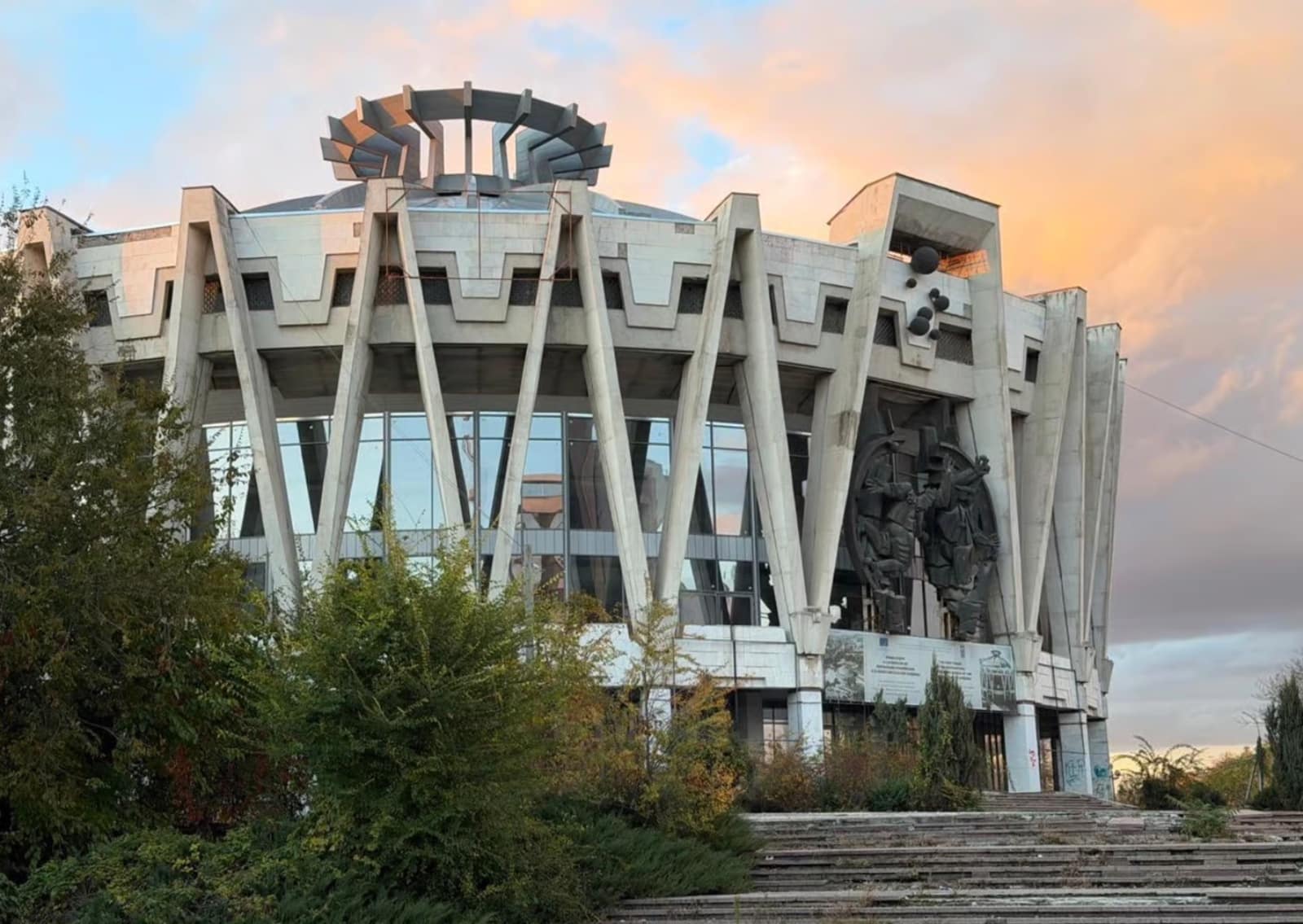
At a more monumental scale stands the Chisinau State Circus. Completed in 1981, the circular building could seat 1,900 spectators, with a 13-meter arena, a removable dome, and surrounding semicircular foyers, murals, and summer terraces. The six main members of the design team—including architects Semyon Shoikhet and A. Kirilenko—received the State Prize of the Moldavian Soviet Socialist Republic for the project. Academically, the circus is regarded as an underrated case within the “international Brutalist” sequence, notable for folding traditional Moldovan decorative elements into the tectonic logic of concrete—a kind of “Brutalism with local warmth.”
The building has been out of use since 2004, and nearly two decades of abandonment have made it prey for urban explorers and architectural photographers. Some researchers note that for many locals the half-ruined circus carries an “immaterial dimension”—it symbolizes prosperity and optimism, a vessel for the collective memory of an era. That emotional dimension is common to many Brutalist buildings: their value was never only aesthetic, but bound up with specific historical experience.
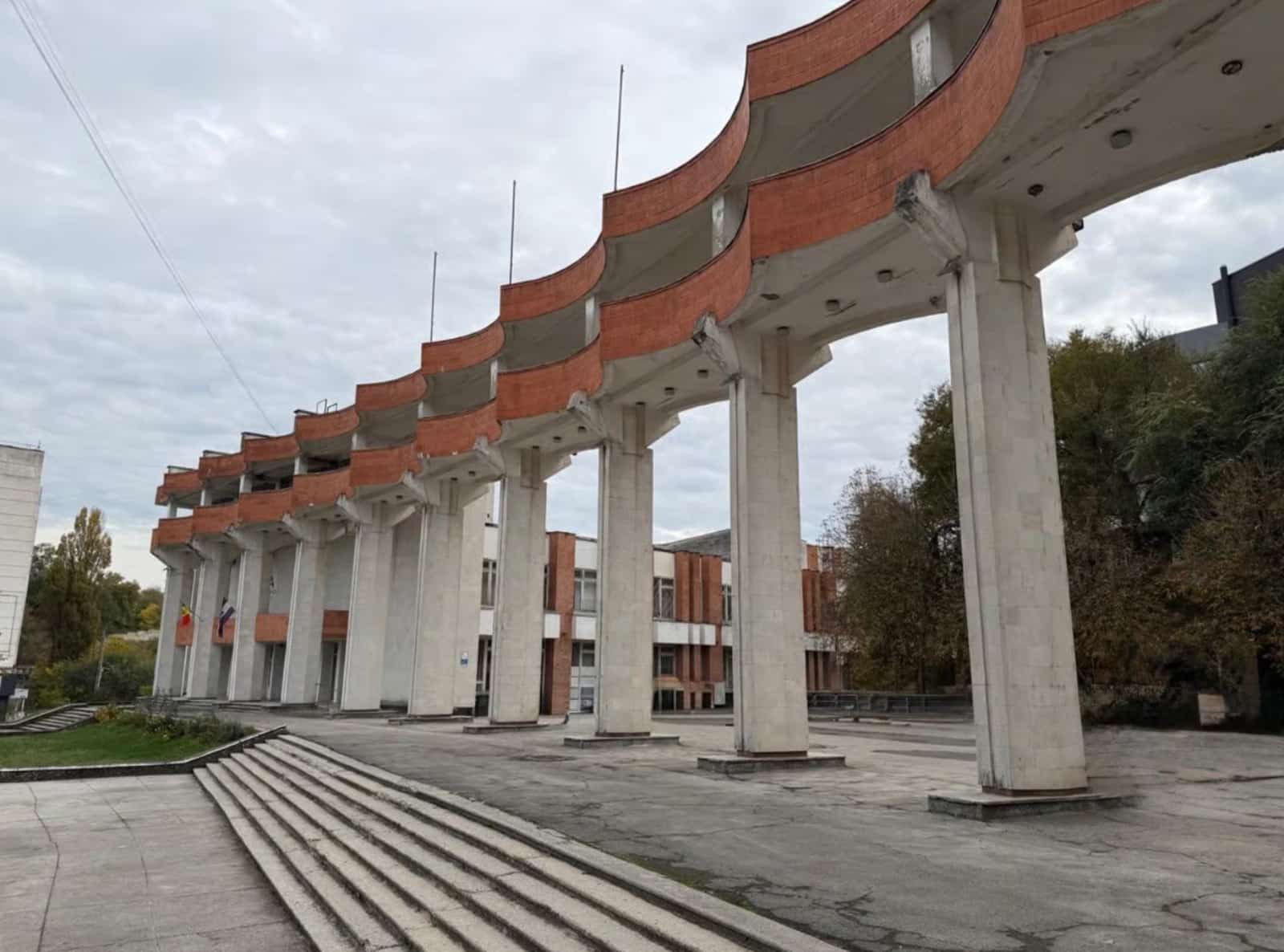
Equally important are the “micro-district” housing estates scattered across the city. These prefabricated concrete panel blocks, built for the working class, may be less dramatic in pure formal terms than the circus, but they form the absolute majority of Chisinau’s urban landscape. For Brutalism enthusiasts, their value lies precisely in their anti-landmark quality: they are not isolated masterpieces but a systematic, mass-produced aesthetic. One travel documentary describes exploring these housing districts and Soviet monuments as a kind of “slow urban exploration,” where the pleasure is not in “seeing” something but in feeling a particular atmosphere.
Why People Are Drawn to It
The question of why Soviet Brutalism in Chisinau attracts visitors has several overlapping answers, and they are not all architectural.
First, there is the aesthetics of honesty. Brutalism does not pretend. Concrete shows its seams, its formwork marks, its imperfections. In an age of renderings, CGI, and glass-and-steel corporate sameness, raw concrete reads as authentic. Travelers who have grown tired of “Instagram architecture”—buildings designed primarily to be photographed from one angle—find in Brutalism a different kind of visual pleasure: one based on mass, shadow, geometry, and the play of light on rough surfaces. Chisinau offers these qualities without the crowds of London’s Barbican or the tourist infrastructure of Belgrade.
Second, there is the political and historical charge. Soviet Brutalism is inseparable from the system that produced it. For some visitors, encountering these buildings is a way of touching a vanished world—not to endorse it, but to understand it physically. The circus, the housing blocks, the administrative buildings: they are evidence of a planned society, of collective aspirations, of a modernity that was supposed to be socialist. In Western Europe, Brutalism is often discussed as an aesthetic or a planning failure. In Chisinau, it is still the everyday environment of people who lived through the transition. That proximity to lived history gives the buildings a weight they would not have as pure form.
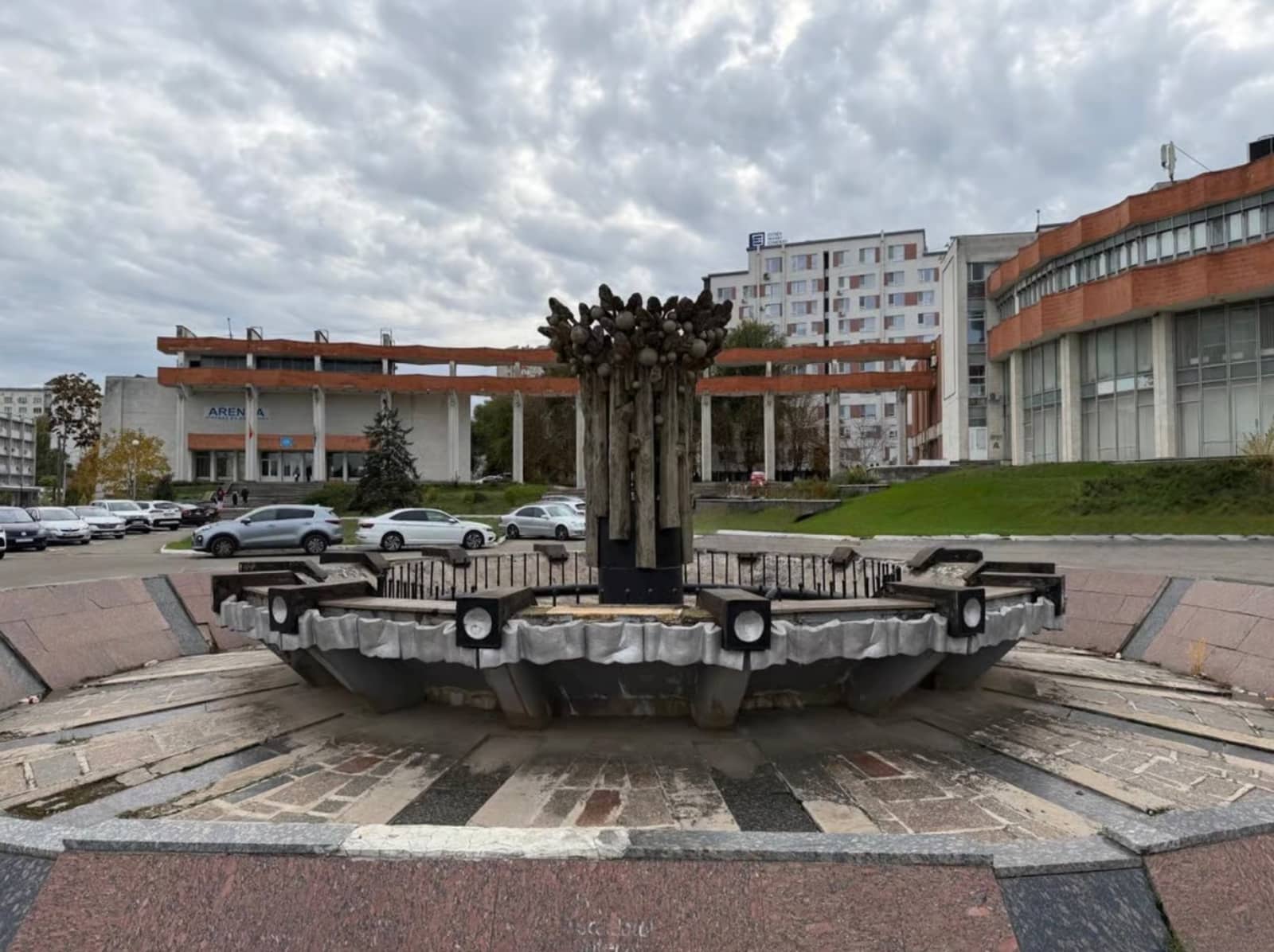
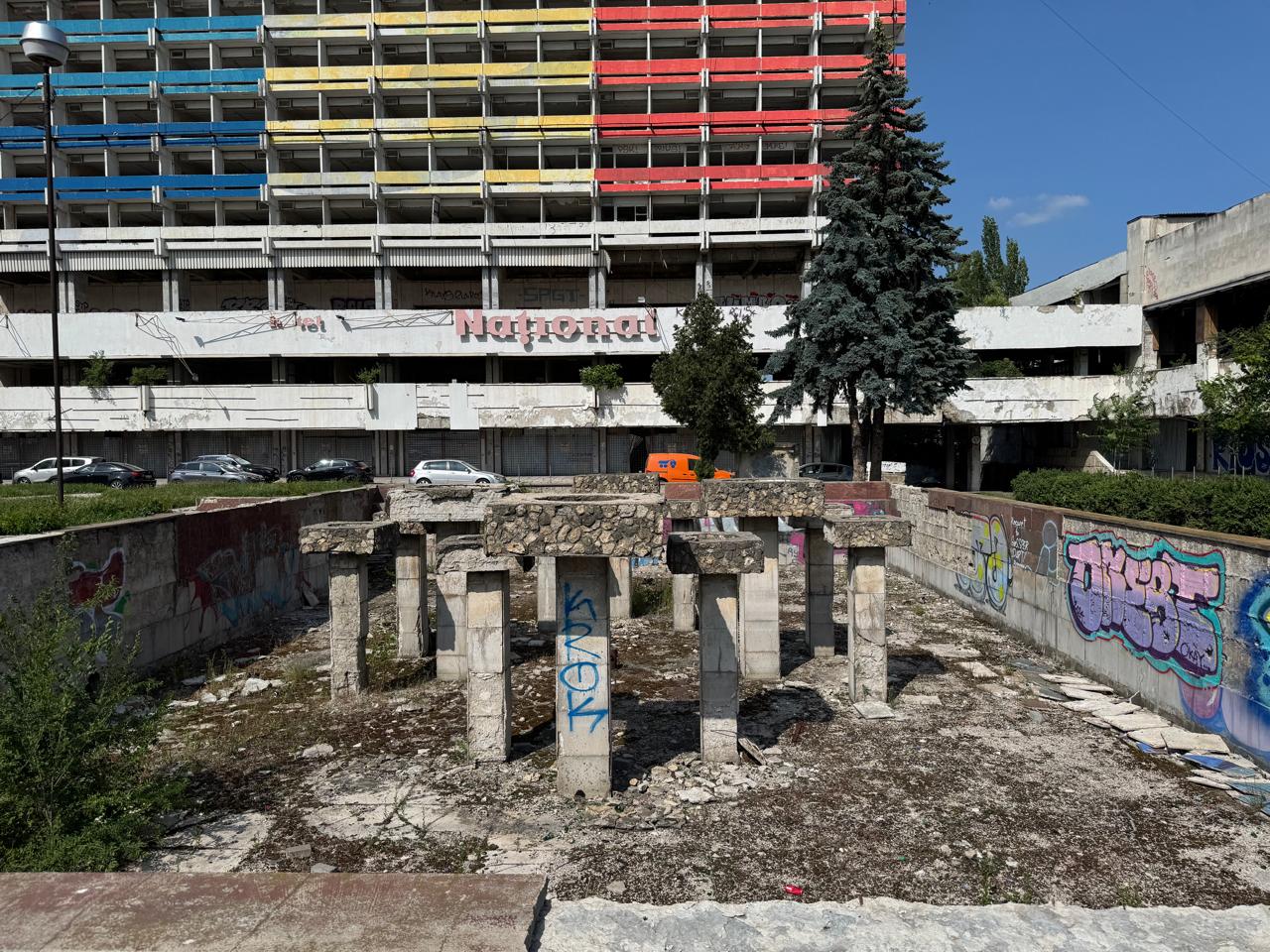
Third, there is the appeal of the under-documented. Chisinau is not Prague or Budapest. Its Brutalist heritage has not been fully catalogued, restored, or packaged for tourism. For a certain type of traveler—the urban explorer, the architecture student, the photographer tired of over-photographed locations—this rawness is the point. There is a sense of discovery, of finding something before it is “discovered.” The Romanita tower’s confusing elevators, the circus’s peeling murals, the housing estates’ repetitive balconies: these are not inconveniences but part of the experience.
Fourth, there is the melancholy. Brutalism in Chisinau is not only about the Soviet past but about what came after. Many of these buildings are in disrepair. The circus is abandoned. The housing estates show signs of poverty and neglect. For some visitors, this decay produces a distinctive melancholy—a sense of grand ambitions brought low, of concrete dreams fading. That mood is attractive to people who find beauty in ruins, who are drawn to the aesthetics of aftermath. It is the same sensibility that draws travelers to Chernobyl, to abandoned Yugoslav monuments, to the relics of East Germany.
Fifth, there is the community. Brutalism tourism is not only a solitary pursuit. Online forums, Facebook groups, and specialized travel agencies cater to people who share this interest. Chisinau has become a meeting point for architects, photographers, historians, and curious travelers. Local guides offer Brutalism tours. Researchers publish guides. The city’s Brutalist heritage is becoming a niche cultural asset, and that social dimension reinforces its appeal.
The Local Perspective
It is important not to romanticize from the outside. For many Moldovans, Soviet-era housing blocks are not aesthetic objects but the places they live, often without adequate maintenance or heating. The circus is not a monument but a failed public building. The Romanita tower is not a photo opportunity but a home. There is a real tension between the external gaze that finds beauty in concrete and the internal experience of living with the consequences of Soviet planning and post-Soviet neglect.
Some locals see the growing interest in Brutalism as a form of exoticization—outsiders finding poetry in what is, for them, everyday hardship. Others welcome it as a way to generate tourism, attention, and possibly preservation. The truth is probably both: the same building can be a burden to one person and a revelation to another. What matters is that the conversation is happening, and that Chisinau’s architectural heritage is being documented before it is lost to demolition or decay.
Why It Matters
Soviet Brutalism in Chisinau matters because it is a reminder that architecture is never neutral. These buildings were designed to house people, to stage performances, to embody a political order. They succeeded and failed in different ways. They are now witnesses to a century of upheaval: war, occupation, Sovietization, independence, transition, emigration. To visit them is to visit that history in material form.
They also matter because they are disappearing. Some have been demolished. Others are threatened. The circus has been closed for two decades. Housing estates face “renovation” that often means demolition. Once gone, they cannot be replaced. The growing interest in Brutalism tourism may help preserve them—or at least document them—before it is too late.
And they matter because they offer a different kind of travel experience. Not comfort, not beauty in the conventional sense, but something more complicated: a confrontation with history, with materiality, with the passage of time. For travelers who want more than a postcard, Chisinau’s concrete landscape is an invitation. It says: look at me, I am still here, I am not pretty, but I am real.
Conclusion
Chisinau is not the first city that comes to mind when one thinks of Brutalism. It has no Barbican, no National Theatre of London, no Habitat 67. What it has is something else: a dense, everyday, unpolished collection of concrete buildings that tell the story of a small country on the edge of empires. For a growing number of travelers, that is exactly the attraction. They come for the Romanita tower, the circus, the housing estates, the monuments. They stay for the atmosphere: the gray light, the wide avenues, the sense of a place that has not been smoothed over for visitors.
Soviet Brutalism in Chisinau is not for everyone. It is not comfortable, not picturesque, not easy. But for those who are drawn to it, it offers something rare: an encounter with the twentieth century in its rawest form. Concrete, after all, is a material of memory. It holds the marks of its making. It ages. It cracks. It stays. And in Chisinau, it is still there, waiting to be seen.
Book your Chisinau Soviet Brutalist tour with Moldova Tours.