The Soviet Mosaic of Chisinau: Tiled Memory and the Travelers Who Seek It
In Chisinau, an art form is quietly vanishing from the city’s surface—even as it draws a growing number of visitors who come specifically to find it. It is not a painting hanging in a museum, nor a sculpture standing in a central square. It is the Soviet mosaic: vast images assembled from thousands of colored tiles, once decorating factories, schools, hospitals, bus stops, and cultural palaces. Today, between fading and peeling, these works have become treasures in the eyes of a particular kind of traveler. Discover Chisinau’s mosaics with a day trip from Moldova tours.
A City with an Unusually High Density of Mosaics
During the Soviet era, Moldova was an important producer of decorative mosaic art. From the 1960s through the 1980s, when Soviet architecture as a whole moved toward functionalism and formal simplification, mosaic remained one of the few decorative mediums still encouraged. In 1954, Khrushchev called on Soviet architects to abandon sculptural ornament on building facades and turn instead to mosaic—ushering in a golden age of Soviet mosaic art. That policy left a deep imprint on Chisinau.
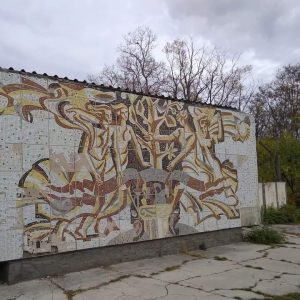
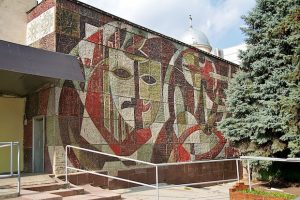
Today, Chisinau is considered one of the cities in the region with the highest density of surviving Soviet mosaics. Walking through the streets, you encounter them in unexpected places: on hospital walls, at factory entrances, on the gable walls of apartment blocks, on the backs of bus shelters. Their themes are often direct and optimistic—agricultural abundance, industrial progress, scientific achievement, friendship among peoples, athletic competition. Made from colored ceramic and glass fragments (smalt), they shimmer in the sun with a brightness that seems to belong to another era.
A volunteer project called Mosaics of Moldova has documented more than 500 mosaic works across the country. Activists are using photogrammetry to create 3D digital archives, because they believe many mosaics are at risk of disappearing. The very existence of this project signals one fact: in Moldova, the fate of Soviet mosaics is far from settled.
The Mosaics Worth Seeking Out
Chisinau’s mosaics are scattered throughout the city, and some stand out for their particular histories.
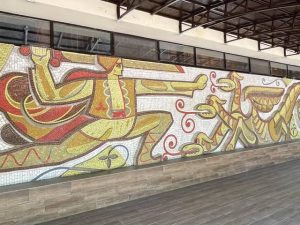
The “Sport” mosaic ensemble is among the most systematic works. Located on the exterior wall of the Ion and Doina Aldea-Teodorovici Culture and Art Center at the entrance to Valea Morilor Park, it consists of twelve separate mosaic panels, each depicting a different sport. The ensemble is listed as a local-level monument of public space in Chisinau, and in September 2026 a full restoration began, carried out by artists Octavian Romanescu and Ion Zabbinsky. The launch of the restoration is itself a signal: the city is beginning to recognize the cultural value of these mosaics.
The “Arta” (Art) mosaic has a history of near-destruction. Created in 1974, the 138-square-meter panel originally stood on the exterior wall of the Trade Unions Culture Palace, featuring the masks of tragedy and comedy alongside traditional Moldovan carpet patterns. When the palace was slated for demolition to make way for a shopping center, local residents, journalists, and activists protested—and the developer eventually agreed to fund the mosaic’s relocation near the Maria Biesu Opera and Ballet Theatre. The transfer was overseen by Valeriu Zabbinsky, a student of the original artist; students carefully removed the panels, numbered them, and reassembled them at the new site. It is a rare success story—in Moldova, mosaic preservation usually ends in failure.
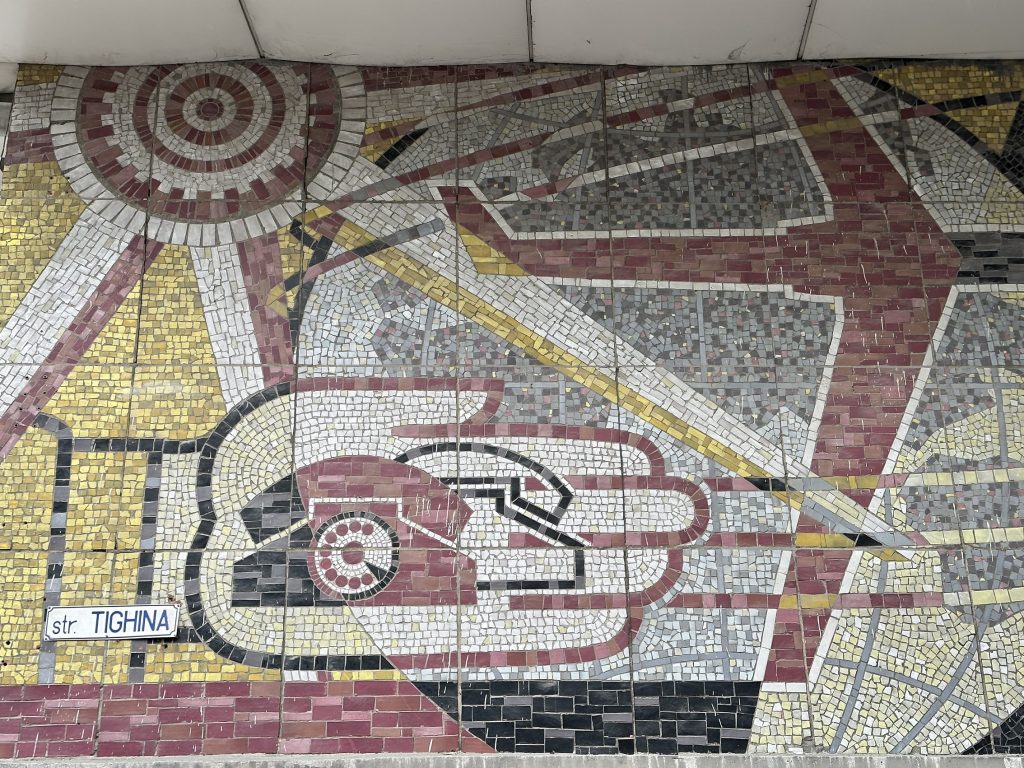
The Moldtelecom building mosaic (1969) is an earlier work by Mihail Buria and Nicolae Cozovan. At its center is a globe, with a red-and-white airplane crossing the image, a hand holding two rotary-dial telephones, and radiating sunbeams extending in red, yellow, and white. The theme is “communication as a force for unity and progress”—a classic socialist modernist allegory. Because it is installed above eye level, it has survived relatively intact, without major loss or fading.
The Petru Movila Street mosaic depicts scenes of Moldovan rural life in the 1970s, blending traditional patterns with socialist realism—a typical example of how visual propaganda of that era merged with local culture.
The Mother and Child Center mosaic focuses on themes of care, health, and childhood, made from colored ceramic and glass fragments. It reflects the optimistic artistic style of the 1970s and 1980s and is now the most striking surviving original design element on the hospital’s facade.
If you are willing to travel beyond Chisinau, the Transnistria region preserves an even denser concentration of mosaics. Tour operators offer private excursions from Chisinau into Bender, Tiraspol, Giska, and Suckleya, seeking out more than thirty mosaics and ten monumental bas-reliefs. Created mainly between the 1960s and 1980s, these works once decorated factories, schools, cultural centers, sports facilities, and bus stops. After 1991, when similar works disappeared en masse elsewhere, a large number of Transnistrian mosaics survived almost untouched.
Why People Come Specifically to Find Them
The appeal of Soviet mosaics to a particular audience can be understood on several levels and why visitors take Moldova tours to discover more..
First, they are a disappearing form of public art. Unlike Brutalist buildings, mosaics are more fragile. A building can be adapted, renovated, and kept in use, but once a mosaic is covered, removed, or weathered away, it is almost irreversibly gone. The relocation of the “Arta” mosaic in Chisinau was the exception, not the rule. The Mosaics of Moldova project explicitly warns that many mosaics face disappearance without protection. This urgency gives the act of seeking them out a “witness before loss” quality. For people who like to capture things before they vanish, Chisinau offers a window in time.
Second, mosaics carry a contradictory emotional charge. A local Chisinau guide, describing the city’s Soviet mosaics, wrote: “Moldova is a typical post-Soviet country. The Soviet era is considered by some to be the worst period in history, and by others the happiest. That is why Soviet elements, such as mosaics, are perceived differently by the population.” This divided perception is itself part of the attraction. For outside visitors, mosaics are not a declaration of political allegiance but physical evidence of how a society remembers and forgets. They are neither a thoroughly rejected past nor a romanticized nostalgia, but something in the gray zone between.
Third, the aesthetics of mosaics are immediate. Unlike the gray concrete of Brutalism, Soviet mosaics are colorful, figurative, even “good-looking.” They depict workers, peasants, teachers, doctors, athletes—the “heroes” of socialist daily life. Assembled from bright tiles, these images stand out sharply against the gray urban background. For travelers tired of abstract modernist architecture, mosaics offer a more direct, more human visual experience. You do not need to understand architectural theory to appreciate a mosaic depicting a harvest scene.
Fourth, hunting for mosaics is a form of urban exploration. Chisinau’s mosaics do not appear prominently on tourist maps. They are scattered across residential districts, industrial zones, hospitals, and school walls. Finding them means leaving the main tourist routes and entering the city’s everyday spaces. The process itself becomes a way of traveling—not to “see” attractions, but to “discover” things. One traveler hunting Soviet mosaics in Uzbekistan described the experience: “The hunt becomes addictive. I would be walking to lunch and suddenly spot a mosaic on a random building three blocks away.” The same experience is entirely possible in Chisinau.
Fifth, mosaics connect to a wider geography. Soviet mosaics exist not only in Moldova. In Uzbekistan, Kyrgyzstan, Ukraine, and Russia, similar public art survives with different themes and styles. For travelers who have already “collected” Soviet mosaics in Central Asia or the Caucasus, Moldova offers a new geographic coordinate and a different set of visual themes—here the mosaics draw more on Moldovan folklore, agricultural tradition, and local symbols rather than Central Asian cotton harvests or cosmonaut worship. Transnistrian tours are especially appealing to those who want to “complete the puzzle,” because mosaics there are often better preserved and largely untouched by tourism commercialization.
The Tension Between Preservation and Tourism
Chisinau’s mosaics are at a delicate moment. On one hand, restoration has begun—the “Sport” ensemble launched a full restoration in 2026, and the “Arta” mosaic was relocated and saved under threat of demolition. On the other hand, most of the more than 500 works documented by Mosaics of Moldova remain unprotected. The fact that activists are using photogrammetry to create 3D archives itself suggests a pessimistic expectation: some things may not survive, and at the very least, a digital record must be left behind.
Tourism plays a contradictory role in this story. Outside interest in mosaics can translate into preservation pressure and funding—as happened when the “Arta” mosaic’s relocation was funded by a developer. But tourism can also reduce mosaics to photo backdrops, stripping them of their complexity as historical witnesses and carriers of public memory. One local guide cautions that most Chisinau residents do not even notice these mosaics; only when travelers show interest do they “become a nice piece of Moldova’s past.” That statement is both an invitation and a subtle warning.
Conclusion
Chisinau’s Soviet mosaics are a peculiar kind of heritage. They have neither been formally commemorated nor systematically erased. They simply continue to exist—on hospital walls, at factory entrances, on the corners of apartment blocks—slowly fading, occasionally painted over, sometimes saved. For those willing to spend the time to find them, these tile-assembled images offer a direct, material encounter with history—not through books or exhibitions, but by walking through the city, looking up, and discovering on some wall a smile that does not belong to this era.
Discover Soviet mosaics on a Soviet history tour in Chisinau with Moldova Tours.