
The Concrete Cosmos: Chișinău’s Hotel Cosmos and the Art of the Brutalist Stopover
In Chișinău, time does not flow evenly. In certain corners it has congealed, taking on an almost stubbornly physical form. Hotel Cosmos is one such frozen coordinate. It is not merely a building; it is a vast meteorite stranded in the middle of the city—coarse, heavy, saturated with mass, utterly at odds with the lighter, glossier commercial structures that have grown up around it. For travellers who come to Chișinău specifically in pursuit of Soviet brutalism, Hotel Cosmos is neither the beginning nor the end of the journey, but it is an unavoidable stopping point. Here they halt, look up, and feel something of another era’s faith in concrete.
A Late Colossus
The story of Hotel Cosmos begins in 1974 but did not reach completion until 1983. A nine-year construction period for a twenty-four-storey building with 380 rooms and capacity for more than 700 guests speaks both to the sluggishness of late Soviet construction industry and to that era’s final obsession with scale. The architects, Boris Banikin and Irina Kolibaeva, gave the building an uncompromisingly declarative posture—a statement of late Soviet modernism in its most confident register.
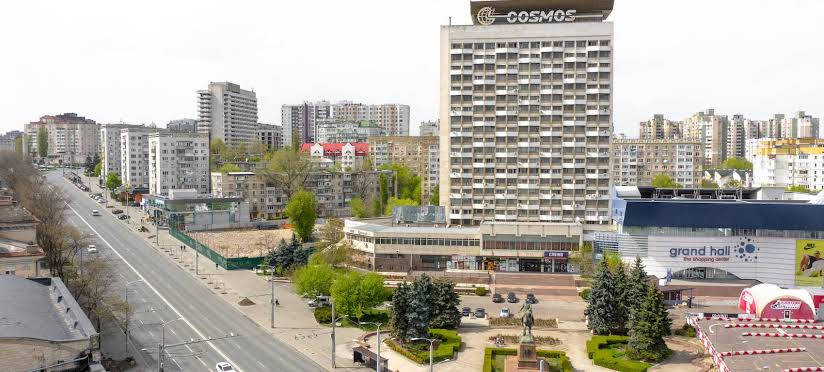
Its siting was pure Soviet strategic rationality: immediately beside Chișinău’s only railway station, close to the central square and bus terminal, eleven kilometres from the airport. In the 1980s, when the average Soviet citizen’s holiday options were firmly bounded by the borders of the Union, the Moldavian SSR unexpectedly became a popular destination. Hotel Cosmos enjoyed its golden years then—summer occupancy reached ninety percent, and from September to November the hotel was almost always full. It was the largest hotel in Soviet Moldova, a monument to trade-union funding, and the first threshold crossed by visitors pouring into this southern republic.
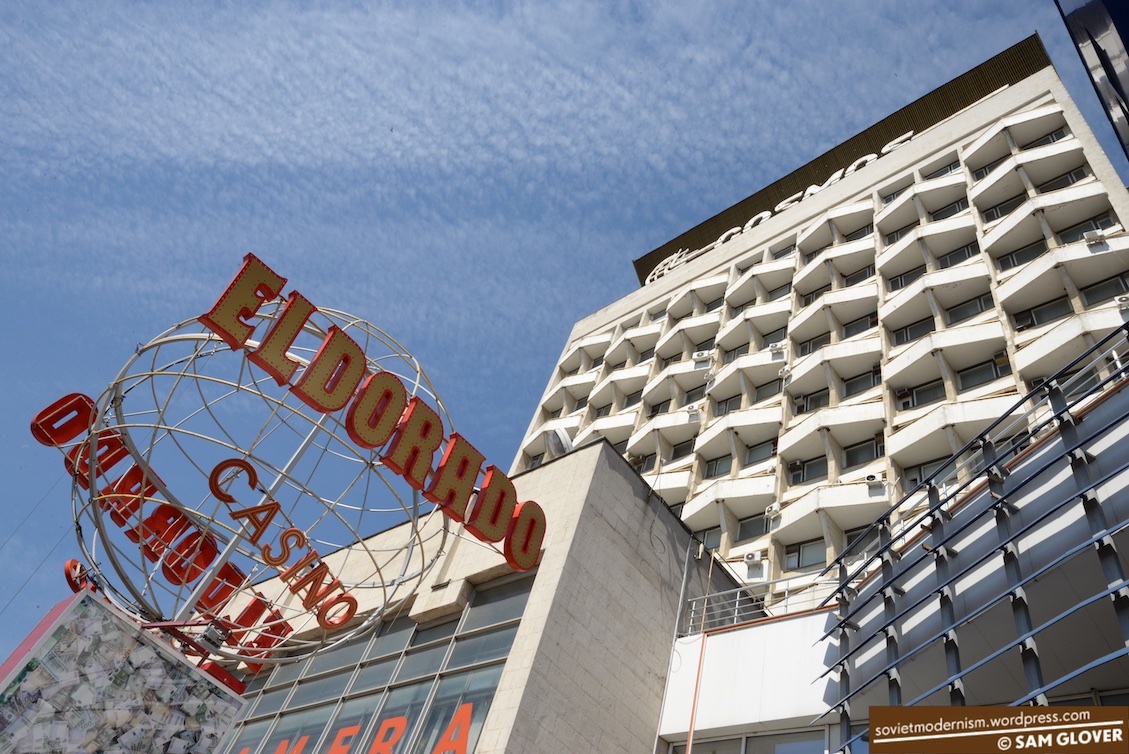
Yet placing Hotel Cosmos within the genealogy of brutalism requires a more careful eye. Strictly speaking, its vocabulary belongs to the late phase of socialist modernism rather than to the purest, coldest brutalism of the post-war years. But travellers do not always cling to academic labels. When they see the vast body stacked from reinforced-concrete frames and precast panels, the heavy horizontal base unfurling across the ground and mezzanine levels, and the way it looks down on Constantin Negruzzi Boulevard with something close to arrogance, they recognise what they came for. The core of brutalism lies not in a precise chronological definition but in an ethical expression of material—concrete that does not cosmeticise, does not conceal, that honestly exposes its structural logic and the traces of its making, even when that honesty means ugliness, means weight, means hostility to comfort and grace. Hotel Cosmos is a faithful executor of that ethic.
Brutalism in the Chișinău Context
To understand why Hotel Cosmos has become a stopover for brutalist travellers, it must be returned to the architectural fabric of Chișinău. This is not a European capital with a long tradition of stone construction. In the twentieth century it endured war, earthquake, reconstruction, and thorough Soviet transformation. What brutalism and socialist modernism left here is a relatively recent face that nonetheless covered two generations.
In 2016 the Romanian association B.A.C.U. (the Bureau for Research into Socialist Modernist Architecture and Art) submitted an urgent proposal to Moldovan authorities to place four buildings on the register of historical monuments: the State Circus, the Romanița residential tower, the Hotel Național, and Hotel Cosmos. The list itself is a miniature pilgrimage map of brutalism. The circus is famous for its boldly brutalist circular volume; Hotel Național is an abandoned and deeply unsettling shell; and Hotel Cosmos is the largest, most functionally complex, and most revealing of the whole set—the one that best embodies the spatial logic of socialist hospitality.
Together these buildings form the skeleton of Chișinău’s brutalist tours. Private Soviet city tours in vintage Lada cars, listed on platforms such as GetYourGuide, explicitly include Hotel Cosmos as a stop, describing it as “a stunning example of Soviet-era hotel architecture.” Another walking route combining wine tasting links the hotel with the Liberation Monument and Hotel Național as essential nodes for examining Soviet-era Chișinău. For deeper travellers, the six-day Moldovan socialist modernism study tour organised by B.A.C.U. and U Tours places Hotel Cosmos alongside the circus, Hotel Național, the Romanița tower, and the network of bus stations built along the Moscow Olympic torch route into a systematic architectural heritage itinerary. Within these programmes the hotel performs a specific narrative function: it shows how brutalism extended from monumental public buildings (the circus) and collective housing (the Romanița tower) into everyday luxury—providing a physical container for a mobile, state-organised tourist economy that matched its ideology.

Book a Soviet tour in Chisinau today
Reasons to Stop: Ruin, Parasite, and the Gaze
Hotel Cosmos no longer operates. Its doors are shut, its rooms empty; the lobby that once received visitors from across the Union now echoes only with traffic from the street. Privatisation began around 2000, followed by comprehensive decay: room finishes deteriorated, bathroom tiles and sanitary fittings degraded, while the public spaces of the ground and mezzanine floors—once home to restaurants, a casino, and conference halls—though slightly better preserved, long ago lost their original functions.
Yet it is precisely this semi-abandoned, suspended condition that gives Hotel Cosmos an attraction travellers cannot resist. Brutalist travel is, in part, never only about the aesthetic appreciation of architectural form. It is a gaze upon decay, a mourning of the material remains left after utopian promises collapsed. Standing before Hotel Cosmos, travellers see more than the design of Banikin and Kolibaeva. They see the silence that followed the cliff-edge decline in visitor numbers after the 1990s, the embarrassment of post-privatisation inability to maintain, and the “parasitic” commercial structures built tight against the hotel’s main body—the Grand Hall shopping centre completed in 2002 and expanded in 2011, the casino embedded in 2008, and other fragmentary commercial additions that replaced the PEOPLE disco that appeared in 2005. Architecturally these additions are a disaster; they cling rudely to the edges of the original volume and destroy the structural integrity brutalism prided itself on. But for travellers, these scars are themselves the story. They are a direct specimen of post-Soviet urban transformation, the stitching of capital across the body of historical heritage.
In front of the hotel, Grigory Kotovsky’s equestrian statue still stands. The bronze figure of the Soviet revolutionary military leader forms a strange echo with the concrete giant behind him. The statue itself is considered by some experts one of the most successful equestrian monuments of the twentieth century, while the figure it represents is a contested memory symbol in today’s Moldova—a Bolshevik hero to some, an insignificant enforcer of violence to others. That contested quality is precisely part of the “complexity” brutalist travellers seek. They do not want a sanitised, fully explained heritage site. They want this unreconciled scene: an abandoned hotel, a disputed horseman, and a heap of aesthetically uncomfortable glass boxes pressed against a historical building.
Book your Soviet history tour in Chisinau today
Its Place in the Itinerary
On a typical Chișinău brutalist itinerary, Hotel Cosmos usually appears in the latter half. Travellers have already seen the pure geometric revelry of the circus and felt the eerie vacancy of Hotel Național. At this point the hotel offers a shock on a different scale: it is not a single monumental object but a complex functional ensemble, a miniature city that once attempted to solve accommodation, dining, entertainment, and business within the socialist city all at once. Its ground level unfolds horizontally, interlocking with the tall guest-room tower in an L-shape or stepped relationship—a layout representative of late Soviet large-hotel design. It reminds travellers that brutalism is not only about monumentality but also about the organisation of everyday life—even if that organisation ultimately failed.
More importantly, Hotel Cosmos is a lingerable object of the gaze. The circus can usually only be viewed from outside; Hotel Național is fenced off; but the hotel, with its vast footprint and relatively open forecourt, allows travellers to walk around it, observing the weathering of the concrete from different angles, the water stains seeping from precast panel joints, the clutter piled behind the ground-floor glass. This bodily, slow circumnavigation is an almost ritualised act in brutalist travel. You walk around it as if reading a vast stone stele eroded by wind and rain.
Conclusion: Hotel Cosmos as Method
In the end, Hotel Cosmos becomes a stopping point on Chișinău’s brutalist tours not because it is a “perfect” brutalist building—academically it may not be pure enough, and in terms of preservation it is far from ideal. It matters because it compresses, in an irreplaceable way, the materiality of brutalism, the historical trajectory of late socialism, the chaos of post-socialist transformation, and the contemporary traveller’s complex desire for “ruin aesthetics” into a single physical site.
Travellers stop here, take photographs, listen to guides tell stories of one-hundred-percent occupancy and 1997 privatisation, then move on to the next stop. But Hotel Cosmos does not easily leave the memory. Its concrete shadow follows them, like a heavy and honest question about the twentieth century: when the world a building once served has disappeared, what remains of the building itself? For the brutalist traveller, the answer may lie in the silent, stained façade of Hotel Cosmos—it says nothing, yet compels everyone who passes to look twice.
Book your Chisinau Brutalist architecture tour in Chisinau today

Bryn Jacobs is a travel advisor and writer specializing in Eastern Europe, with a particular focus on Moldova, Romania, and the wider Black Sea region. Over the past decade, he has built a reputation as one of the most knowledgeable and trusted voices on travel to Moldova—a country he believes remains one of Europe’s most misunderstood and underappreciated destinations.