The Gates of Chișinău: How Two 24-Story Soviet Towers Became the City’s Most Ambiguous Welcome
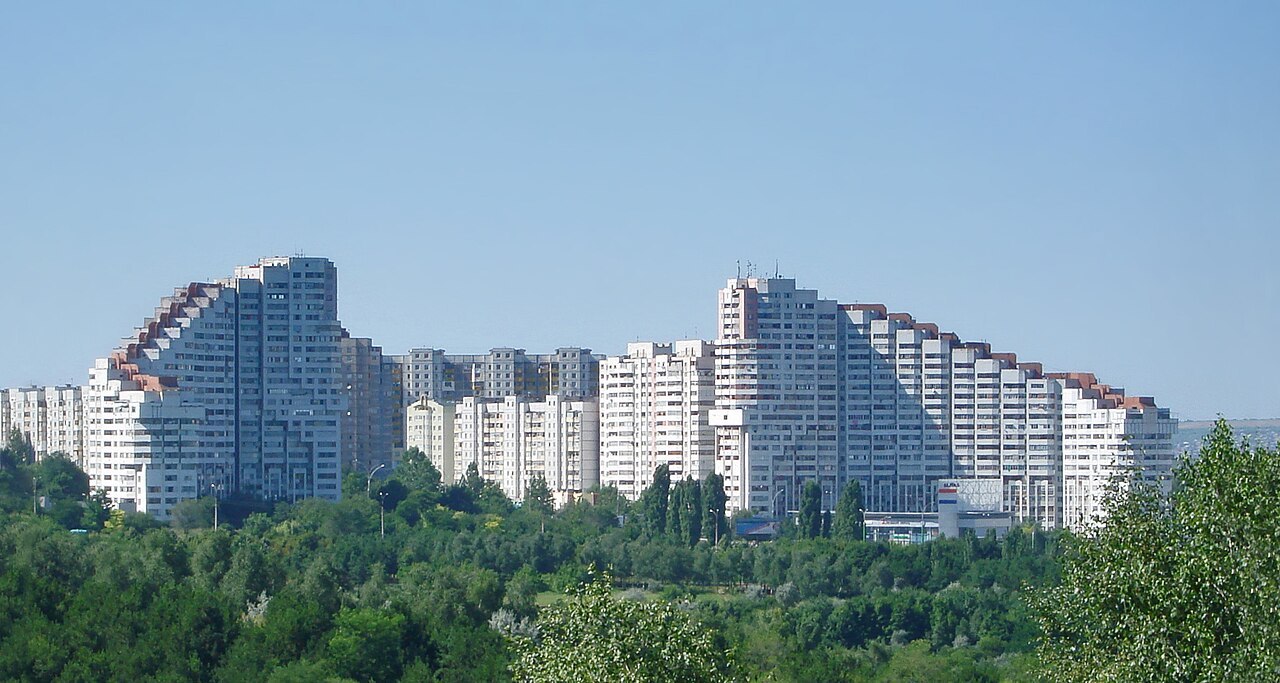
The buildings known as the “Gates of Chișinău” are not one monument but a pair of concrete towers standing 70 meters tall on Dacia Boulevard, and their nickname is both a civic boast and a quiet confession. Built between the late 1970s and 1987 at the southern entrance to the capital, where the road from the airport meets the city, these 24-story residential blocks were designed to frame the arrival experience—two massive symmetrical volumes that, from a distance, appear to open like a gate . For tourists on Soviet-themed tours, they are often the first Soviet structures seen after landing, a concrete welcome committee that sets the tone for everything that follows. For locals, they are home—and a home that has never been repaired, where balconies crack and plaster falls, and where the promise of a monumental gateway has long since given way to the unglamorous reality of lived-in decay . The Gates of Chișinău are, in this sense, the perfect introduction to the city: a monument to ambition that is also a monument to maintenance deferred.
The Architecture of Arrival
The Gates were conceived in the late 1970s and early 1980s as a deliberate urban gesture. The plans were drawn by architects Iulia Skvorțova, A. Markovici, and Anatol Spasov, working from an initial idea by architect Iuri Tumanean . The ensemble consists of reinforced concrete towers, the largest reaching 24 floors and approximately 70 meters in height, positioned on either side of Dacia Boulevard in the Botanica sector . To the left stands the Chișinău Zoo; to the right, the Botanical Garden . The placement was not accidental. Travelers arriving from Chișinău International Airport would pass between these two concrete sentinels, and the effect—from a distance, at speed—was intended to be monumental.
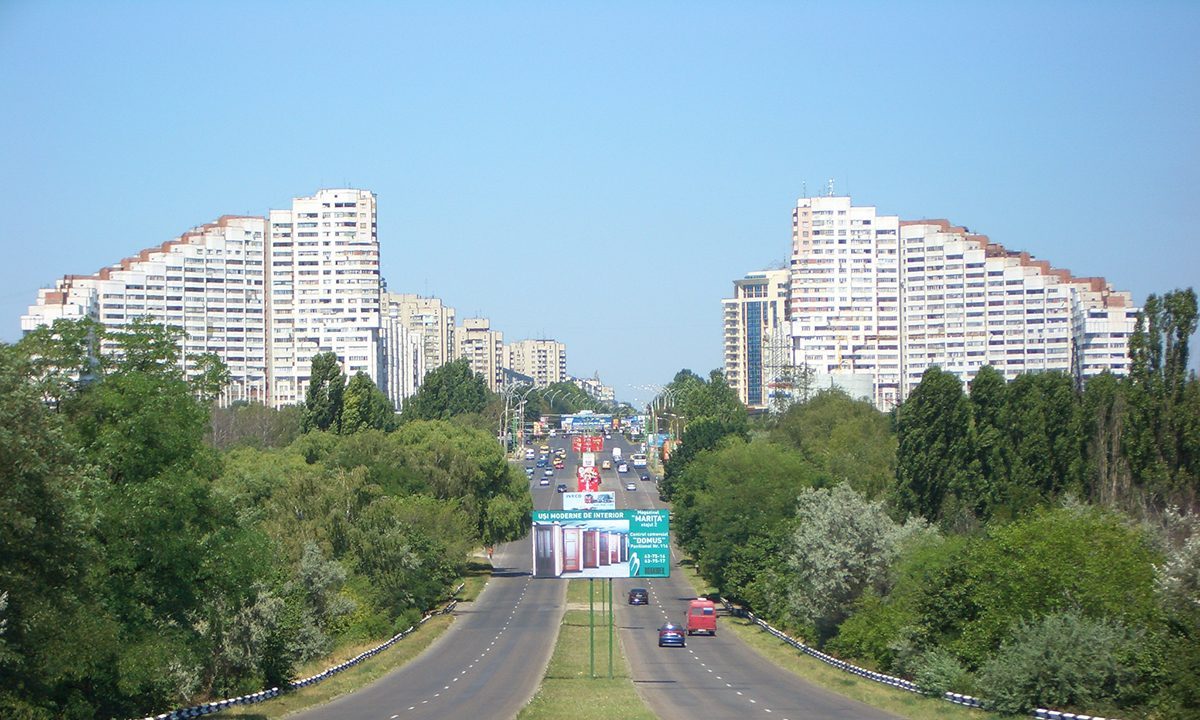
The design reflects the late Soviet architectural vocabulary: simple geometric forms, robust massing, and an efficient use of space that prioritized density over ornament . The towers were multifunctional in principle, with residential apartments above and commercial or service spaces at the lower levels . They were not brutalist in the most aggressive sense—there is no raw concrete expressionism here—but they belong to the same family of large-scale socialist modernist housing that defined the skylines of countless Soviet cities. Their symmetry is their defining feature: two matching volumes that, viewed from the approach road, create a visual frame. The nickname “Gates” was not an official designation but a popular one, and it stuck because it described what the buildings were clearly trying to do .
The Gap Between Metaphor and Maintenance
The gap between the Gates as symbol and the Gates as buildings is where the real story lies. A Moldovan television report from 2025 documented the condition of the towers with uncomfortable specificity: facades shedding plaster, walls full of cracks, a persistent and difficult-to-endure smell . Residents described a building that had never undergone a proper renovation since it was commissioned. One woman who had lived there since the towers opened told the reporter that “on the upper floors water leaks very often” and that “the electrical network needs renovation, the elevator too, because it is a multi-story building” . Another resident pointed to cracks in the balconies large enough that “a child could fall through freely if not supervised by parents” .
The municipality’s response illustrates the structural problem. Two years before the 2025 report, Chișinău City Hall allocated 18 million lei for the rehabilitation and illumination of the Gates’ facades . The work never began. The contractor who won the tender cited rising material prices, and the money was insufficient . A deputy head of the municipal housing directorate explained that the problems are not only technical but legal: owners must organize into associations and establish clear rules for common spaces before the city can act . The Gates, in other words, are caught in the transition from state-owned housing to privatized apartments—a transition that left no single entity responsible for the whole.
This is the paradox that makes the Gates compelling to visitors interested in the Soviet legacy. The buildings were designed as a collective statement—a gateway for a socialist city—but they have become a collection of privately owned units with no collective mechanism for their own preservation. The metaphor of the gate implies passage, transition, a controlled entry. The reality is stasis: a structure that welcomes others while slowly failing those inside.

Soviet tours in Chisinau book today
Why Soviet Tours Stop Here
The Gates of Chișinău occupy a peculiar position in the tourism economy of the city. They are not typically listed as a headline attraction on Soviet walking tours, which tend to focus on the city center—the Parliament, the Presidency, the National Hotel, the Romanita tower . The Gates are too far south, too residential, too far from the pedestrian circuits that structure most guided walks. But they are unavoidable for anyone arriving by air, and their sheer scale makes them a reference point that guides can invoke even from a distance.
For tours that do venture into the Botanica sector, or for private drivers ferrying tourists from the airport, the Gates serve a different function: they are the first evidence that Chișinău’s Soviet heritage is not confined to a few photogenic ruins in the center. The towers are inhabited. They are not abandoned like the National Hotel, not contested like the Romanita. They are simply lived in, and their decay is the ordinary decay of neglect rather than the dramatic decay of conflict. This ordinariness is precisely what makes them valuable to tourists seeking an authentic encounter with the post-Soviet condition. The Gates are not a museum piece. They are a neighborhood.
The buildings also benefit from a certain visual drama that photographs well from a moving vehicle. The approach from the airport along Dacia Boulevard produces a cinematic effect: low-rise buildings give way to open space, and then the towers appear, symmetrical and imposing, framing the road ahead . Travel writers have noted that they are “impossible to miss” when arriving from the airport, and that they offer “magnificent panoramas of the entire capital, especially when illuminated by city lights” . The view from the upper floors—for those who live there or visit—is one of the best in Chișinău, a panorama that the buildings’ own deterioration has not diminished.
The Gates in the Broader Landscape of Soviet Heritage
The Gates of Chișinău are part of a larger, increasingly contested inventory of Soviet-era architecture in the city. The National Hotel, the Cosmos Hotel, the Romanita tower, the State Circus—all have been the subject of preservation campaigns, scholarly proposals, and public debate . The Gates have received less attention from preservationists, perhaps because they are residential and therefore harder to frame as a single monument, or perhaps because their architectural value is considered lower than that of the more distinctive structures in the center. The ICOMOS Heritage Alert issued in 2026 focused on the Republican Stadium Complex, not the Gates, arguing that the stadium’s gates and administrative building constitute “a rare surviving example of early post-war socialist realist sports architecture” . The Gates of Chișinău, by contrast, are late Soviet modernism, less ornamental and less immediately legible as heritage.
Yet the Gates are heritage of a different kind: they are evidence of how the Soviet state imagined the experience of arrival, and of how that imagination was realized in concrete and then left to the devices of privatization. They are also evidence of the post-Soviet condition in a more intimate register than the grand ruins of the center. The National Hotel is a monument to corruption and failed development . The Romanita is a monument to engineering ambition and structural neglect. The Gates are a monument to the ordinary residents who live in a building that was never finished being cared for. For tourists interested in Soviet nostalgia, this is perhaps the most honest encounter available: not a ruin to be photographed, but a home to be acknowledged.
The View from the Gate
Standing at the Gates of Chișinău, one is positioned between two temporalities. Behind, the road leads to the airport and to the world beyond Moldova. Ahead, the boulevard leads into the city, toward the center, toward the monuments and the museums and the walking tours. The towers themselves face both directions: their facades are visible to those arriving and those departing, and their residents live in the interval. The nickname “Gates” suggests a threshold, a point of transition. But gates are also structures that control access, that decide who enters and who is kept out. The Gates of Chișinău no longer control anything. They are simply there, two concrete volumes marking the place where the city begins, waiting for a renovation that has been funded but not begun, inhabited by people who describe their homes in the language of emergency. For the visitor interested in what the Soviet project became, rather than what it intended, the Gates are not a stop to be checked off a list. They are the first thing to look at closely, because they are the first thing the city shows you, and what they show is everything at once: ambition, symmetry, decay, and the stubborn persistence of ordinary life inside a monument that was never meant to be ordinary.
Book a Chisinau brutalism tour today