
The Concrete Relic: Why Chișinău’s National Hotel Became a Pilgrimage Site for Soviet History and Brutalist Longing
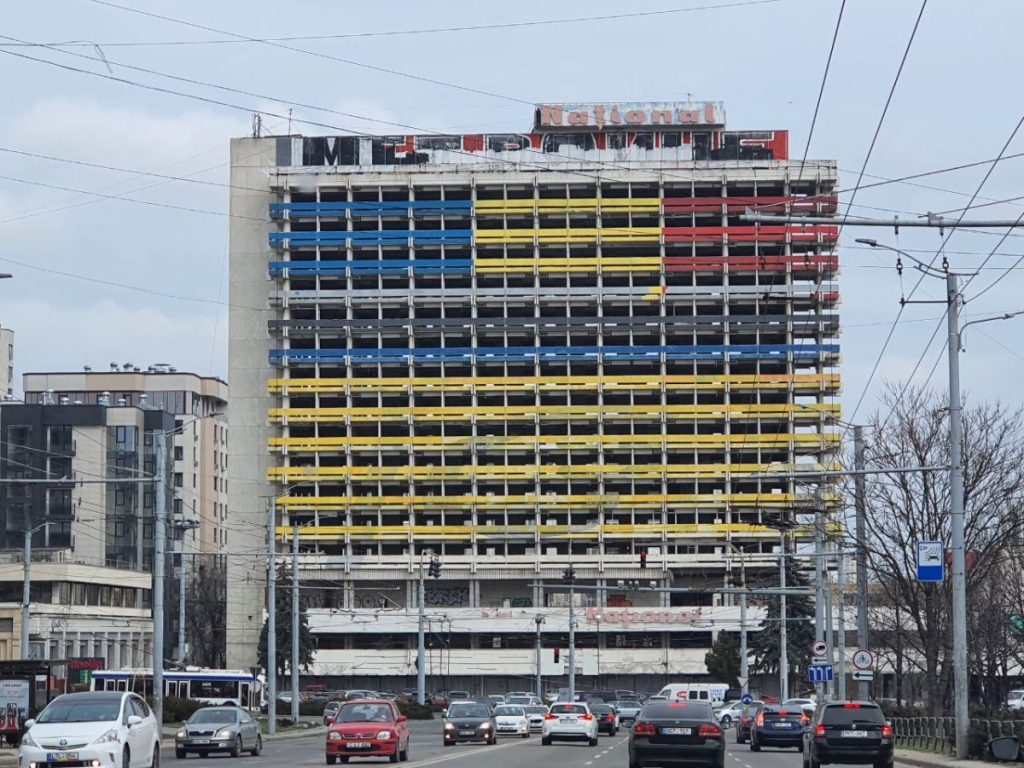
The National Hotel in Chișinău is not merely an abandoned building. It is a 17-story contradiction: a former jewel of Soviet modernity that became a monument to post-Soviet dysfunction, and precisely because of that fall, a magnet for travelers seeking the raw, unpolished remnants of a vanished world. Completed in the 1970s as the Intourist Hotel, this socialist modernist hulk now stands with boarded windows and stripped interiors, yet its very decay has made it an essential stop for those chasing brutalism and Soviet history in Moldova’s capital . To understand why people visit, one must understand both what the building was meant to represent and what it has become.
A Flagship of Soviet Modernity
The building was constructed in Chișinău—then the capital of the Moldavian Soviet Socialist Republic—and finished in either 1974 or 1978, depending on the source . Designed by architects A. Gorbuntsov and V. Shalaginov, the 17-story structure was operated by Intourist, the Soviet state travel monopoly, and served as one of its flagship properties . According to The New York Times, after its opening the building “became a proud symbol of the Soviet Union’s embrace of modernity” . It was a four-star hotel primarily booked by foreign visitors and Soviet celebrities, a controlled gateway through which outsiders could experience a curated version of Soviet Moldova .
Its amenities reflected a peculiar Soviet cosmopolitanism. The hotel had three bars, on the 3rd, 14th, and 17th floors. The 14th-floor bar was particularly unusual: it accepted 14 currencies, including non-Soviet ones, and was the only currency bar ever built in Chișinău . The property also included a connected restaurant with 160 seats and two additional halls seating 200 and 100 guests respectively . For a republic on the western edge of the Soviet Union, the Intourist was a statement—concrete proof that the system could produce spaces of international standard, wrapped in the confident geometry of socialist modernism.
Architecturally, the National belongs to the broader tradition of Soviet modernism, often loosely grouped under the brutalist umbrella. Brutalism, derived from the French béton brut (raw concrete), found fertile soil in the Soviet Union’s peripheral republics after Stalin’s death, when ornament was stripped away and concrete acquired unprecedented expressive power . Chișinău’s version of this style was not monolithic: Moldovan architects enjoyed a degree of creative freedom within the union framework, producing buildings that borrowed covertly from local symbols and experimented with bolder structural solutions . The National Hotel, with its sheer vertical mass and unadorned façade, embodies that moment when Soviet architecture chose mass, shadow, and geometry over decoration.
The Fall: From Flagship to Ruin
The hotel’s decline is inseparable from the collapse of the system that built it. Intourist withdrew from Moldova after the dissolution of the Soviet Union, and the property was taken over by MoldovaTur, a former Soviet and newly Moldovan state-owned company, in 1992. It was renamed the National Hotel at this time . Guest bookings dropped significantly after the 1992 Transnistria War . What followed was a decades-long saga of failed privatization, murky offshore dealings, and legal disputes that The New York Times would later describe as “a study in the post-Soviet dysfunctions of one of Europe’s poorest countries” .
In 1999, MoldovaTur agreed to sell the hotel to the Israeli company Avi Awaks for US$1.55 million, but the deal fell through . MoldovaTur was purchased by the private company Alfa Engineering in 2006, which promised to invest in the property. Instead, the building was left to decay as ownership changed multiple times and the Great Recession hit . By the mid-2010s, much of the interior was wrecked or had been carried off . In 2021, the hotel’s new owner, Vladimir Andronachi, asked the local government for permission to demolish the building and replace it with office space. The request was temporarily granted, then reversed amid government infighting and public pressure . In 2022, a court overseeing a money-laundering case against Andronachi ordered the hotel held as potential compensation .
Today the building is effectively a ruin. Its entrances are boarded up, but the interior remains relatively easy to access. The former lobby is marred with human excrement and broken bottles; fixtures, wiring, windows, and decorative marble tiles have been stripped. Squatters and homeless individuals use it as a refuge between police sweeps . Anetta Dabija, a city councilor with the preservation group Save Chișinău, has said she would never enter the hotel alone out of safety concerns . And yet, this very state of decay is what draws a particular kind of traveler.

Soviet back to the USSR tours in Moldova book today
Why They Come: The Pilgrimage to Brutalism and Soviet Memory
The people who seek out the National Hotel are not typical tourists. They are architectural pilgrims, urban explorers, photographers of the derelict, and travelers for whom the Soviet past is not an abstraction to be read about but a physical texture to be walked through. Their reasons overlap, and they are not all purely architectural.
First, there is the aesthetics of honesty. Brutalism does not pretend. Concrete shows its seams, its formwork marks, its imperfections. In an age of renderings, CGI, and glass-and-steel corporate sameness, raw concrete reads as authentic . Travelers who have grown tired of “Instagram architecture”—buildings designed primarily to be photographed from one flattering angle—find in brutalism a different kind of visual pleasure: one based on mass, shadow, geometry, and the play of light on rough surfaces . The National Hotel, even in ruin, offers these qualities without the crowds or the curation of a museum.
Second, there is the allure of the authentic Soviet artifact. For enthusiasts of Soviet history, Chișinău offers something increasingly rare: a city where the Soviet past is not confined to museums or theme restaurants but remains embedded in the living—and dying—fabric of the urban landscape. The National Hotel is a particularly potent example because it was a showcase property, a place where the Soviet state performed its modernity for foreign eyes. Commercial Soviet-history tours in Chișinău now explicitly advertise walks “among gigantic brutalist buildings, abandoned hotels with a post-apocalyptic aesthetic, and hidden corners that most tourists will never see” . The National, as the most prominent abandoned hotel in the city center, has become an unspoken stop on this informal circuit.
Third, there is the political and symbolic charge of the building’s decay. The National’s façade has become a canvas for geopolitical expression. In 2022, after Russia’s full-scale invasion of Ukraine, graffiti artists painted a large Ukrainian flag on the building. Others subsequently overpainted parts of that flag with symbols related to Russia and its invasion, including the orange and black lines of the St. George ribbon and Russian military symbols . In June 2024, it was repainted with the Moldovan flag . The building’s body has become a surface upon which Moldova’s contested identity—between Soviet nostalgia, Russian influence, European aspiration, and national assertion—is literally written and rewritten. For visitors interested in the politics of memory, the hotel is not just a building; it is a live document.
Fourth, there is the lure of the ruin itself. Urban exploration, the practice of visiting and photographing derelict and abandoned places, has a devoted following, and the National Hotel offers a textbook specimen: a once-glamorous structure reduced to a stripped concrete shell, accessible despite the boards, dangerous but not inaccessible. The New York Times noted that the building “provides a safe space for amorous couples unbothered by the stench of urine and a lure for fans of urban exploration” . This is not a niche for everyone, but for those who practice it, the National is a destination.
Book a Soviet tour of Chisinau today
Chișinău as a Brutalist Destination
The National Hotel’s appeal is amplified by its context. Chișinău as a whole has become a quiet pilgrimage site for brutalism enthusiasts, and the National is one node in a broader landscape. The city’s Romanița residential tower, a circular high-rise built between 1978 and 1986, is often compared to a flying saucer and remains a beloved—if flawed—piece of living brutalist fabric . The Chișinău State Circus, completed in 1981, is regarded academically as an underrated case within the international brutalist sequence, notable for folding traditional Moldovan decorative elements into the tectonic logic of concrete . The city’s “micro-district” housing estates, vast fields of prefabricated concrete panel blocks, offer what one architectural guide describes as an “anti-landmark” aesthetic: brutalism not as isolated masterpiece but as systematic, mass-produced environment .
For the traveler who comes to Chișinău seeking this inheritance, the National Hotel occupies a special place because it is simultaneously monumental and ruined, iconic and accessible, historically significant and legally contested. It is the kind of place that preservationists fight over precisely because it cannot be replaced: a 17-story document of what the Soviet Union wanted to be, and of what happened after that wanting ended.
The Struggle Over Memory
The fight over the National Hotel’s future is also a fight over how Moldova will remember the Soviet period. Preservationists argue that the building is a cultural asset with European significance, an emblem of socialist modernism whose rehabilitation could contribute to the region’s tourist circuit . Anetta Dabija, the city councilor, said she had not been a fan of socialist architecture but decided the National was worth saving after visiting Berlin, where iconic structures of the Communist era have been restored . “People often hate modernist buildings, but that is not an excuse for demolition,” she said .
Others see it differently. Valeriu Pasa, head of the anti-corruption group WatchDog, called it “a monument to corruption in Moldova” . For him and others, the building’s decay is not a tragedy of lost architectural heritage but a symptom of a system that allowed a prized public asset to be captured by oligarchs and left to rot. Dmitri Potapov, one of the graffiti artists who painted the Ukrainian flag on the façade, argued that since the hotel “gained its private status through dubious means in the 1990s,” it must be returned to the state or turned over to squatters, and that the main concern should be preventing its demolition .
As of 2024, demolition plans remained on hold due to the ongoing legal case and preservationist advocacy . The building stands in limbo: too valuable to demolish without a fight, too degraded to restore without enormous investment, too politically charged to ignore.
Conclusion: The Value of the Unresolved
The National Hotel attracts visitors precisely because it has not been resolved. It is not a restored museum of Soviet life, nor a glossy boutique hotel, nor a cleared lot awaiting development. It is a contradiction held in concrete: a symbol of Soviet ambition, a victim of post-Soviet corruption, a canvas for geopolitical graffiti, and a playground for urban explorers. For those who seek Soviet history and brutalism in Chișinău, the National offers something that no curated exhibition can: the physical sensation of standing inside a system’s failed promise, surrounded by its material remains, with the wind coming through broken windows and the smell of decay in the air.
That is not an easy experience, and it is not meant to be. It is, instead, an honest one. And in a city where the past is still being argued over, that honesty has become a strange kind of attraction.
Book a Soviet history tour package in Chisinau today

Bryn Jacobs is a travel advisor and writer specializing in Eastern Europe, with a particular focus on Moldova, Romania, and the wider Black Sea region. Over the past decade, he has built a reputation as one of the most knowledgeable and trusted voices on travel to Moldova—a country he believes remains one of Europe’s most misunderstood and underappreciated destinations.